Friday, January 20, 2017

Practitioner Perspective: Weaving Goals, Reflection, and Transferable Skills into the Curriculum

This week's blog post is from regular contributor Lindsey Halman, founder and teacher on the Edge Academy Team in Essex.


Each Monday on the Edge Academy Team at Essex Middle School, we have a full team meeting, called Gathering Meeting.  This meeting serves a number of purposes - it builds community, it provides opportunities for youth leadership, it’s fun, and most importantly it is the opportunity to share the Edge Goals for the week.  These goals guide our work and provide our learners with a clear vision of what they can expect for the week.  

In order to ensure we support our learners in understanding what it means to have self-direction and communicate clearly and effectively, we ask that they share their weekly goals with a parent/guardian or trusted adult on Monday (see Link to Goals Memo Template) and write a reflective email to that same adult(s) on Friday (see Link to Weekly Reflection/Letter Template).  These opportunities allow us to ensure that there is clear communication between home and school and that our students are taking responsibility for their learning.


TEMPLATES:


Examples from Students:


VT Transferrable Skills:
Self Direction: Take initiative in, and responsibility for, learning.
Clear + Effective Communication: Demonstrate Organized and Purposeful Communication.


Notes on Goals
Deadline
Steps to Completion for the Due Date
Clear and Effective Communication
  • Share notes about goals with parents by end of Monday.
  • Filling out table.
  • Friday email home due Friday.
  • Share doc with parents on Monday.
  • Sharing follow up due Friday.
Future Projects
  • Develop two driving questions that will guide project work and research.
  • Share evidence on Protean
  • Due date: Friday 1/13
  • Listen in class about driving questions.
  • Develop quality driving questions.
  • Post evidence on Protean.
  • Due FRIDAY!
Civic and Social Responsibility
  • Field Trip on 1/13  Friday  (Patin Libre)
  • Watch video by 1/10 Tuesday be prepared for Humanities.
  • Flynn Teaching Artist on Thursday
  • Bring layers for Friday
  • Watch video about Patin Libre on own time before Tuesday afternoon.
  • Bring layers on Friday.
  • Possibly sign up to lead future gathering meetings.
PLP
  • Post evidence on Protean about one or more goals
  • Post on Protean 2 Humanities Goals.
  • Post 2 Driving Questions
  • Create a reflection
  • DUE FRIDAY.
  • Post the evidence about the various goals.
  • Write a reflection
  • DUE FRIDAY!
Humanities
  • Unit planning and Goal Setting Google Form DUE TUESDAY
  • Launch new unit
  • Choose new book groups
  • Flynn teaching artist
  • Fill out Google Form
  • Submission DUE TUESDAY
  • Prepare for performance on FRIDAY
Science
  • Windmill packet DUE FRIDAY
  • Detailed response paragraphs typed up on Google Docs
  • Fill out packet in math class.
  • Type up detailed response paragraphs.
  • DUE FRIDAY


****This week is PROJECT’S WEEK****
In order to meet my goals this week, I will….
Work hard, have perseverance, and  put in 100% effort
I might need support with…
Driving questions
Thanks for looking over my notes and I will inform you of my progress on Friday!


Examples of Friday Reflections - Weekly Letters Home

Dear Mom and Dad,

This week has been a successful week for me because I completed all of my weekly goals. For the Edge weekly goals, I completed everything except the posting of evidence to Protean (Which I am about to do as soon as I finish this letter.) I created my two driving questions for my yearly project this week. My project goal for next week is to really get into the research and take a lot of notes. In Physical Education, we got split into two groups : Basketball and Weightlifting. I, fortunately, got put in the group that starts with weightlifting. One highlight from the week was the fact that we started a new unit in Humanities and we are going to have book groups. I am really excited to know which book I will be reading. One goal for next week is to get a good grade on my algebra midterms.
Sincerely,
Jessy

Dear family,
              
                    This week has been a fun week for me. We finished our windmill task which was great to learn the engineering design process and how to build things on Tuesday we heard a speech from a teacher that went to Cuba she told us about the way they live and how it is very hard to try to make it to america and how different are schools are. In projects we are creating driving questions for our future projects. My highlight of the week was today we went to go see Le Patin Libre, they are a ice dancing group that defies ice dancing stereotype this show was very unique and I'm glad that I got to experience it. My goal for next week is to learn something I never knew before.

 Sincerely, Natasha

Dear Mom and Dad,

This week has been pretty busy, with Paige and I making our flan and going to Micaela's to work on projects. This week we also worked on writing our driving questions to help lead our project research. After finishing those, Micaela and I used a directory of LGBTQ staff at UVM (given to us by someone who visited the Edge team named Erin) to find some possible people to interview for our book. We can hopefully start drafting next week. Something else we'd like to do is meet up after school on as many Wednesdays as possible to get some extra work done.

In DTE, we've finally finished constructing our car and we've timed it on the track. It made it to the other end in about 10 seconds, and we're working to make it go faster.

In Spanish, our flan went great! Some people found it too sweet for their liking, but Senora Psaros said it was perfect. I also feel like the presentation in itself went well.

Ms. Wager (she does lessons for the woodwinds) gathered everyone in districts to practice yesterday.

One highlight from this week was making the flan with Paige. That was fun.

One goal for next week is to set up some meeting dates to interview at least one of the people that responded to the emails Micaela and I set up. We'd have to get some help from Phil and Lindsey to do that, though, and we'd also have to create some questions.

See you later!
M


Friday, January 6, 2017

Teaching Through A Lens of Personalization


Today's post is by Don Taylor of Main Street Middle School in Montpelier.

For many teachers, the move to proficiency-based assessment and personalized learning, as mandated by Act 77, has been cause for rethinking and revamping curriculum. One approach to renewing the curriculum is to consider taking on traditional subjects through the personalized learning perspective.
Recently, students in my classroom completed the novel Fever 1793. Integrated into a study of culture and the migration and movement of people, technology and disease, the novel provides an easy-to-access platform for literary analysis that most students enjoy.
More importantly, when viewed through our personal learning framework, which focuses on identity, growth and reflection, and transformation, the novel provides a great literary example of a young adolescent girl’s maturation from self-absorbed teen to responsible young woman. For our middle level students, the examination of the main character’s identity, in conjunction with her developing relationships, provides a parallel to the personalized learning work completed earlier in the year.

After reading the novel and in preparation for writing a short analysis piece, students were asked to create a relationship web for the main character Matilda “Mattie” Cook. Once created, classroom discussion focused on Matilda’s relationships that helped her survive the yellow fever epidemic raging through 1793 Philadelphia.
Students identified how Mattie’s relationships influenced her through different stages of her growth and the principles and values revealed through those relationships. These discussions, along with examination of themes, use of language, and relevant evidence from the novel, were the background information provided to students prior to writing. Based on this approach to the novel, writing prompts were adjusted to reflect these changes in the curriculum. Students were given the choice of addressing three different prompts:

Prompt #1
Select a character from the story who has had a significant impact on Mattie’s growth as a person. Explain the importance of this character and how Mattie’s relationship with this character helps Mattie grow into a responsible young adult.
  Prompt #2
Identify and explain the most important event of the story and how Mattie’s
actions (and reactions) during this time represent her growth and transformation.

  Prompt #3
Identify the most important principle or value that contributed to Mattie’s growth as a young woman. Describe how this principle or value helps Mattie survive the yellow fever epidemic and contribute to her community.

As we move through the writing process, I will be soliciting feedback from students as to whether this focus on the elements of personalized learning helped them to develop a deeper understanding of the main themes in the novel.
From the practitioner’s perspective, these changes in curriculum were relatively innocuous. That said, the ability to make connections through personalized learning, in conjunction with our understanding of the middle level experience, can make the language arts experience more relevant and motivating for students.


Wednesday, November 30, 2016

PLP Pathways: Practitioner Perspective

Today's post was contributed by Don Taylor, language arts and social studies teacher at Main Street Middle School. Follow PLP Pathways on Twitter @PLPpathways.

Practitioner Perspective

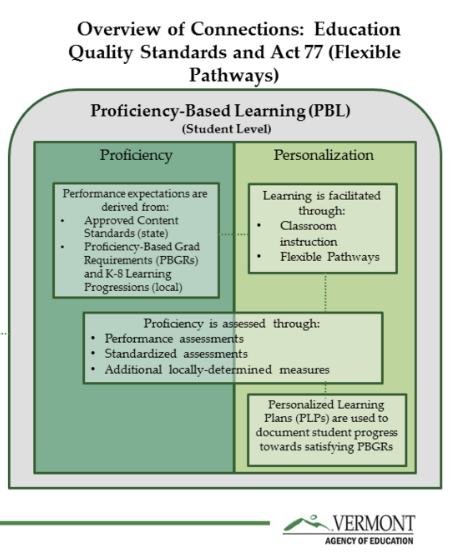
Act 77: Flexible Pathways seeks to achieve a number of important outcomes. Among these, proficiency-based learning, personalization, and flexible pathways to graduation have primary importance. This we know. Additionally, all students are expected to have a personalized learning plan that demonstrates evidence of content area and transferable skill proficiencies as they progress through their learning program.

Screen Shot 2016-10-11 at 9.55.09 PM.pngOver the past few years, teachers across the state have devoted enormous amounts of attention, energy, professional development, and collaborative effort to merge these ideas into seamless, effective, and meaningful learning experiences for students.

Ongoing Questions

Thus far, how are we doing? What strides have been made towards moving schools, teachers, and programs towards proficiency-based assessment? Has personalization been achieved and to what level are students invested in their personal learning plans? How are teachers and students involving families? The community? Is access to opportunity equitable across schools, communities, and the state?

Finally, how are teachers, on a daily basis, integrating the three pillars of personalized learning: personal learning plans, proficiency-based assessment, and flexible pathways into curriculum planning and development?

These are huge questions and over the course of the next few months, the staff and contributing writers to PLP Pathways will attempt to address them in a cohesive and meaningful way.

As part of our mission, we hope to clarify and assist educators across the state of Vermont as they tackle these thorny topics, develop strategies and pedagogies that help students succeed, and test drive resources and technologies that we can then share out to collaborative contributors.

In The Classroom

As a classroom teacher, I’m continually working to balance personalization with proficiency-driven assessment and the demands of content and curriculum. Full disclosure: my experience with personalized learning and PLPs indicates that these platforms are more motivating and engaging for students. As a result, I’m seeking to integrate personalization and proficiency-based assessment into a project-based learning environment. I’d like the PLP to be the foundation for student engagement, to capture student growth and proficiency, and to be the driver of curriculum development.

Second full disclosure: it doesn’t always work. I’m still striving to create a cohesive, student-driven curriculum that engages students while preparing them for the demands of the 21st century. This often requires a rethinking of what’s been done in the past, structured reflection, and collaborative discussions with colleagues that help solve problematic issues. Still, since working with personalization and proficiency-based assessment, I’ve started to develop some classroom survival strategies. Here are three.

Models

PLP Template.pngIt’s been really important to have models available for curriculum and personal learning plan development. The adjacent template, the current model for our PLPs, was developed over two years of trial and error. It’s not perfect, and it might not work for every team and school, but having a consistent PLP model allows me to focus on coordinating themes in the curriculum.

Curriculum Example

Because our PLP model includes a page on citizenship, we’ve been able to take traditional units on the Constitution and government and tie that more closely to student ideas about rights and responsibilities. This year we hosted a mock election prior to the presidential election. Students were able to engage with ideas about participation and citizenship which were then posted to the PLP. By collecting evidence of citizenship on the PLP, we hope to build a strong community of interested, critically thinking members, who are involved in the community.

Furthermore, asking students to reflect on these events and topics using proficiency-based assessments (descriptive writing, research skills, geography, structures of government) seems more viable when students have a school-based citizenship activity to reference.

Having a strong PLP model allows us to capture student learning and evidence while at the same time emphasizing a personal learning experience.

Feedback

Without constructive student feedback, current practices would not be nearly as developed. With the help of Google Forms, I am continually asking students for their honest and appropriate feedback regarding all aspects of personalized learning and curriculum development.

More importantly, I try to share the collected data with the students for constructive discussion.

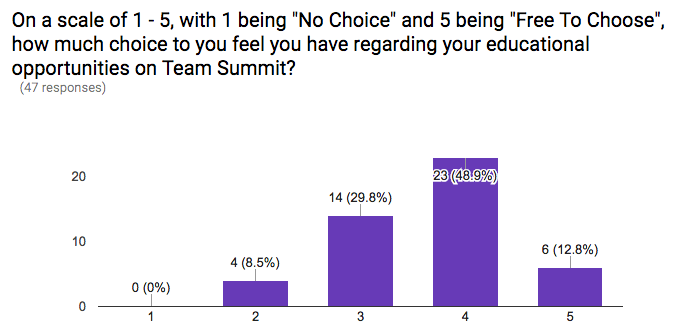
Screen Shot 2016-11-30 at 5.29.23 AM.pngFor example, after our most recent unit, students were asked about their freedom of choice within the academic offerings.

Their responses, adjacent, indicate that while they do feel they have some choice, it could certainly be improved.

This specific feedback is a great place to start discussions with students. It also helps to direct future curriculum development. Eventually, the hope is that rather than having students responding after the learning, they can help me develop choice ahead of the unit’s implementation. However, without this initial feedback, my teaching and thinking would not be as efficient.

Project Based Learning

At the middle level, the sooner I can get kids involved in engaging projects the better. Our district utilizes Understanding By Design principles and often, we attempt to have the essential questions reflected in project-based learning activities. Projects can be developed with student input and additionally, they can be structured to allow for student choice.

Once those projects are in place, students can be asked, or better yet, can choose, the different proficiencies and transferable skills that they would like to demonstrate. Those skills are then captured through the gathering of evidence on the student’s personal learning plan. Indeed, once students are engaged in project-based learning, students can be expected to be learning on several different fronts. First, they should be working on the proficiencies and skills required to be successful and second, they can be self-reflective decision-makers who can honestly evaluate the strengths and challenges of their learning experience. I view this as moving students from recipients of their education to active, engaged, independent learners.

Curriculum Example 2

Last year, after working with students to build background information about the Middle Ages, students were given the opportunity to work on a Middle Ages Independent Project. Given a choice of options regarding the demonstration of their learning, students utilized a wide range of technology platforms to present their developing proficiencies.


One student figured out how to use Google Sketch-Up to create a model of a medieval castle. Self-direction, self-discipline, ideas about audience and effective presentation all came into play. Moreover, that development and their continuous reflection was captured by the student’s PLP.


Conclusions


New initiatives such as Act 77 can have huge benefits for students and teachers. That said, they can also increase stress, cause confusion, and undermine teacher efforts to create cohesive, manageable learning experiences. Often, dialing back and reflecting on the foundation of one’s practice helps to put things in perspective. These three elements of my practice -- strong models, student feedback, and project-based learning -- are sustainable, will provide students with the opportunity for personalization and proficiency, and continue to areas of focus for my professional growth and learning.

Friday, November 4, 2016

The Second Pillar: Proficiency Based Learning


Today's blog is from PLP Pathways contributor Kevin Hunt. Kevin teaches grades 5 - 8 on the Swift House at Williston Central School. He can be reached @kmphunt22 on Twitter.

Recently, at a faculty meeting, the topic of discussion was proficiency based learning. We watched a comprehensive video called “What’s the Deal with Proficiency Based Learning” and chatted with colleagues about some of the big take- aways and implications for our teaching.

While I was listening to the conversation, I couldn’t help but to think about our last PLP Pathways webinar and the discussion we had about proficiencies and their place within the PLP structure. Between the video and insights I heard from my colleagues, four main points of connection stood out: growth mindset, evidence of work toward mastery, personalization, and transferable skills.

Growth Mindset

Proficiency, as it is explained in the video, is a combination of knowledge and skill. In order to demonstrate that you are proficient at something, you need to know and understand the various details associated with that activity, and you need to demonstrate that knowledge and understanding by applying it to a specific task.

Becoming proficient takes practice and assumes that mistakes are going to be made before mastery is reached. Take riding a bike for an example. You can learn about where the pedals are, how the gears work, how to apply the brake, understand where and when you should be biking...and so on.

When you go to actually apply that knowledge the first time, you may wobble around and even fall over. That doesn’t mean you stop, but rather keep practicing and build from your mistakes until you become proficient. The belief that you can achieve something with practice and learn grow from mistakes is at the core of having a growth mindset.

When we encourage students to practice and we put more emphasis on communicating their growth toward a proficiency versus giving them a score on their progress, we are building a culture that is grounded in growth mindset. Imagine getting a grade when you were first learning to ride a bike. Every time you fell off, D, F...would you continue to get up and try?

Evidence Based

Another shift that we have seen across the state is the development of the PLP and the structures around creating PLPs. Many schools have been using tools such as Google Sites and Protean as a medium for the PLP. This portfolio model allows students to create goals, provide evidence of growth, and reflect on their progress, all on the same platform.

As the video linked above says, “grading does not tell the whole story,” but rather various pieces of evidence linked to a skill, target, or standard will give you a wholesome look at a student’s progress towards mastery.

On Swift House, we have students create a goal for each of the transferable skill categories and collect evidence of growth on these goals throughout the trimester. We ask that students find at least four pieces of evidence for each goal and indicate how the evidence connects to their goals. This ongoing collection of evidence allows students to not only see their progress, but it also reminds them that this process isn’t all or nothing.

It is okay to fail and make mistakes along the way. They aren’t being assessed based on an average of grades they receive; instead they are compiling evidence from various work or activities they have done, inside or outside of school, that shows they are putting the effort in and working toward achieving a goal. This model is directly related to academic proficiencies in the classroom. We use formative assessments as communication of their work toward a learning target throughout a unit and students are able to see their growth and learn from their mistakes as they work toward proficiency.

Personalized

The end goal of proficiency is to demonstrate mastery. This is definitely a big shift for many educators as there needs to be a level of flexibility with student work and how they are demonstrating mastery. Students will have the ability to use various digital media, communication, and visual evidence to show they understand and have knowledge of the content. Unless you are specifically assessing the medium, such as writing, there is no longer a requirement for a standard essay or multiple choice quiz. That’s not to say these can’t be options, but if the end goal is for students to demonstrate mastery, then there needs to be flexibility and choice for the students to do just that.

Transferable Skills

In one of the last segments of the proficiency based learning videos, they discuss the link to transferable skills and how colleges are using proficiencies to evaluate prospective students. These transferable skills are often at the core of schools proficiency based grade requirements (PBGRs) and include: communication, creative and practical problem solving, integrative thinking, self-direction, and citizenship. These skills are present inside and outside of the classroom and the development of these skills will assist students throughout their lives.

One worry for many families, especially at the high school level, is how the move to proficiency based learning will affect their college enrollment. The fact of the matter is many colleges have been looking at proficiency-based reports for some years. Having a proficiency based report will not undermine your chances of  getting into a college, but rather it will show the college or university the various content and skills that you have become proficient in. The colleges and universities will be able to see specific mastery for a variety of content, rather than an arbitrary grade.

As we all continue this transition to proficiency based learning, it is so important to realize that there is a network of educators who are going through the same transitions. We should continue to learn from and collaborate with each other as we embrace this shift. Even having a face to face discussion with colleagues at a faculty meeting, whom I don't regularly get to see, was so valuable in that we were able to have a conversation about worries and concerns and brainstorm different solutions and ideas together. I strongly believe that this work, at the core, is going to have a drastic and positive effect on student learning and engagement.