Showing posts with label identity. Show all posts

Wednesday, September 27, 2017

Building Identity Units Through the Personal Learning Framework

Today’s post is brought to you by Don Taylor, language arts and social studies teacher at Main Street Middle School in Montpelier and co-director of PLP Pathways.

The school year is in full swing and as we build our learning communities, developing an understanding of student identity and their strengths and challenges is a critical step for educators.  Most middle schools around the state have structures that work towards these goals. Specifically, teacher’s advisory, multiage teaming, and personal learning plans are all tools that can help teachers understand individual student needs, Using this knowledge to develop strong relationships with students and families can pay long-term dividends in student engagement and achievement.

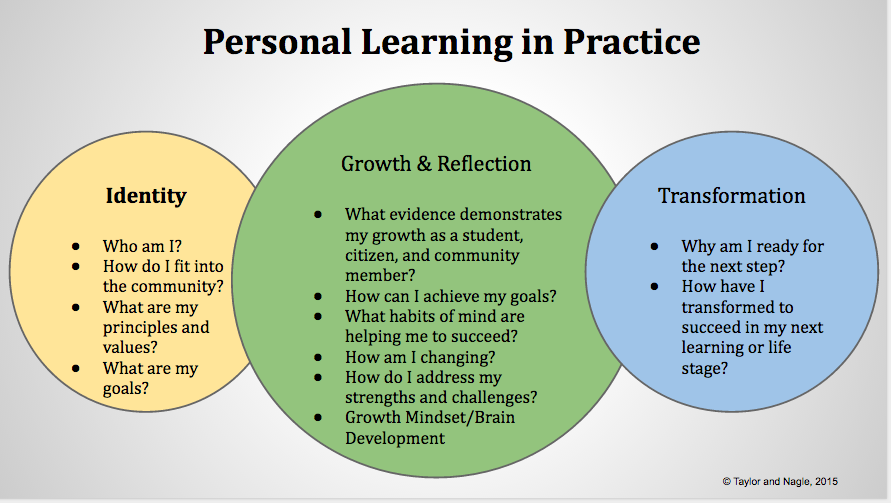
PLF.pngAnother tool that PLP Pathways has been using for the past several years is the Personal Learning Framework. Through the identification of specific stages in the student learning process, the framework can help teachers develop personalized learning activities that support positive relationships, identify key student dispositions, and inform the construction of curriculum that is relevant, engaging, and appropriate.

Personalized Learning Activities

The first six weeks of our program is built around the Identity phase of the Personal Learning Framework. Rather than have students read, write, and think about esoteric topics that might miss the mark, students are asked to evaluate their strengths and challenges, to identify principles and values as reflected through their positive relationships, and to closely observe both their immediate learning environment and cultural norms of the school and community.  

Teachers around the state have developed innovative activities that also integrate standards-based proficiencies into these activities. Samples of these lessons can be found here. The result is that teachers are gaining better insight into their students’ skill sets, leveraging that understanding into the development of strong student-teacher-family relationships, and having students post identity-based evidence onto their PLP.

The benefits of integrating proficiency-based learning activities into an identity unit is clear. Teachers gain a deep understanding of students often leading to positive relationships. Second, adolescents are engaged when activities focus on their needs, skills, and potential. Furthermore, by systematically planning identity activities, teachers can develop personalized curriculum that supports student growth and learning. As you move forward, consider using the Personal Learning Framework as a lens to develop curriculum and activities that enrich and focus your understanding of students into effective teaching practice.

Sunday, October 2, 2016

PLPs in the 9th Grade

This week we will be featuring a post authored by Alison Gauthier, a PLP Pathways contributing author, participating PLP Pathways webinar moderator,  and Science teacher at U-32 Middle and High School in East Montpelier.

Here at U-32 Middle and High School in East Montpelier, I feel that I started this new academic year as an extension from last year. In the spring of 2015, the Administrative Team asked for volunteers to form a Ninth Grade Team of Teachers (Social Studies, Math, Science and English) who would model Proficiency-Based Learning (PBL) as our incoming Class of 2020-ers graduate from 8th grade. As a team, we met several times in the summer to discuss consistencies across the core subjects as well as wrap our minds around PBL. I feel that we hold a responsibility as a team for rolling-out PBL effectively and being flexible to shifting mindsets in education. For Science, the two of us worked EXTENSIVELY to put our best foot forward in terms of what PBL should look like for Science and how we can differentiate process and product for our learners.

Three weeks into the academic year, I will honestly admit that personalization has not been on the forefront. There is a high level of anxiety (among teachers, learners and parents alike) related to PBL, and I feel that we need to put out PBL “fires” before being able to personalize instruction. That seems contrary, I admit, to the mission of PLP Pathways and personalization taking the forefront from which PBL can be achieved. But this is where we are as a school and community. As of Thursday, September 15th, our ninth grade learners have the PLP/SLO Portfolio site on their chromebooks. This site is a place to hold their Personalized Learning Plans as well as the artifacts they collect related to the Student Learning Outcomes (Content Standards and Transferable Skills they will need to demonstrate proficiency in in order to earn their HS diploma). The mission for the next few weeks is to work as a team to help learners document their IDENTITY through their interests, needs, strengths, learning styles, and values.  

Tuesday, September 20, 2016

Personalization, proficiencies, flexible pathways - the Three Pillars!


This week we will be featuring a post authored by Lindsey Halman, a PLP Pathways contributing author, participating PLP Pathways webinar moderator,  teacher, and founder of The Edge Academy, Essex Middle School.

Personalization, proficiencies, flexible pathways - the Three Pillars!  

As another school year launches, I am reminded of how truly fortunate we are to be educators in VT. I am also reminded that in order to create a learning environment that supports the Three Pillars, we must spend time intentionally creating community, building relationships and creating the norms that will allow all learners to thrive in this world of Act 77.  

Creating Community. What is place?  

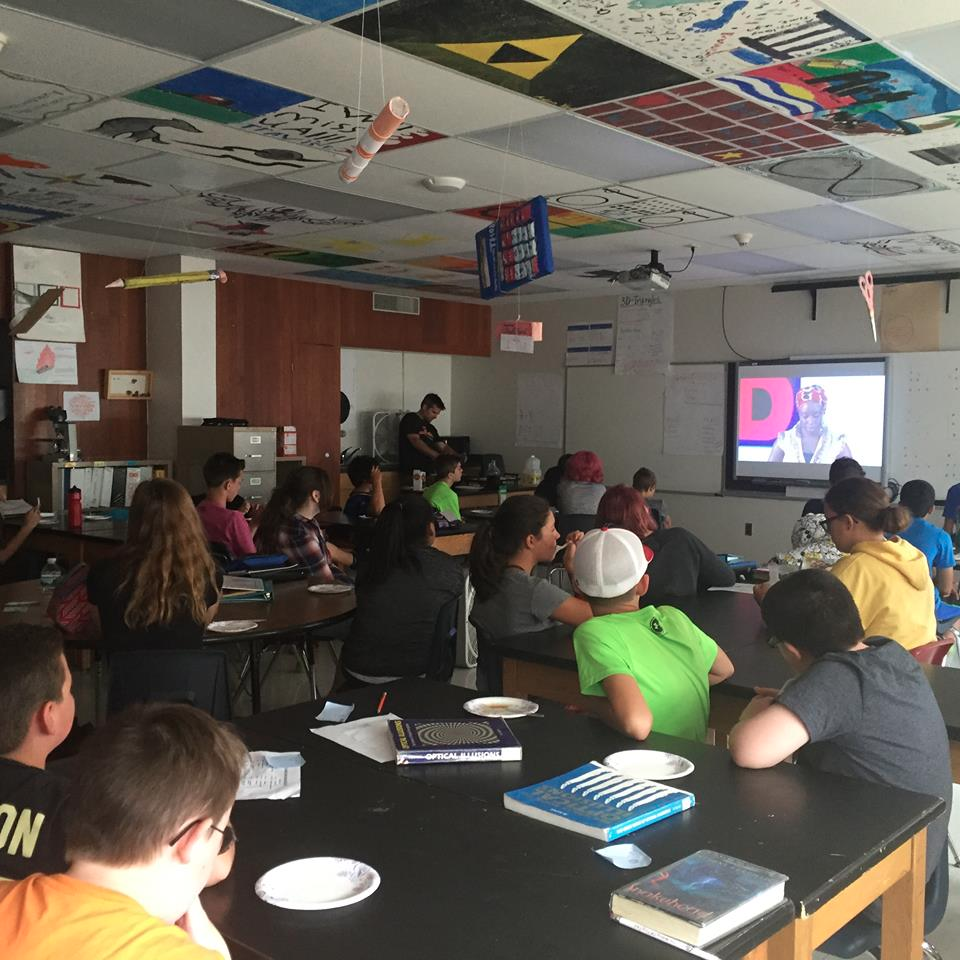
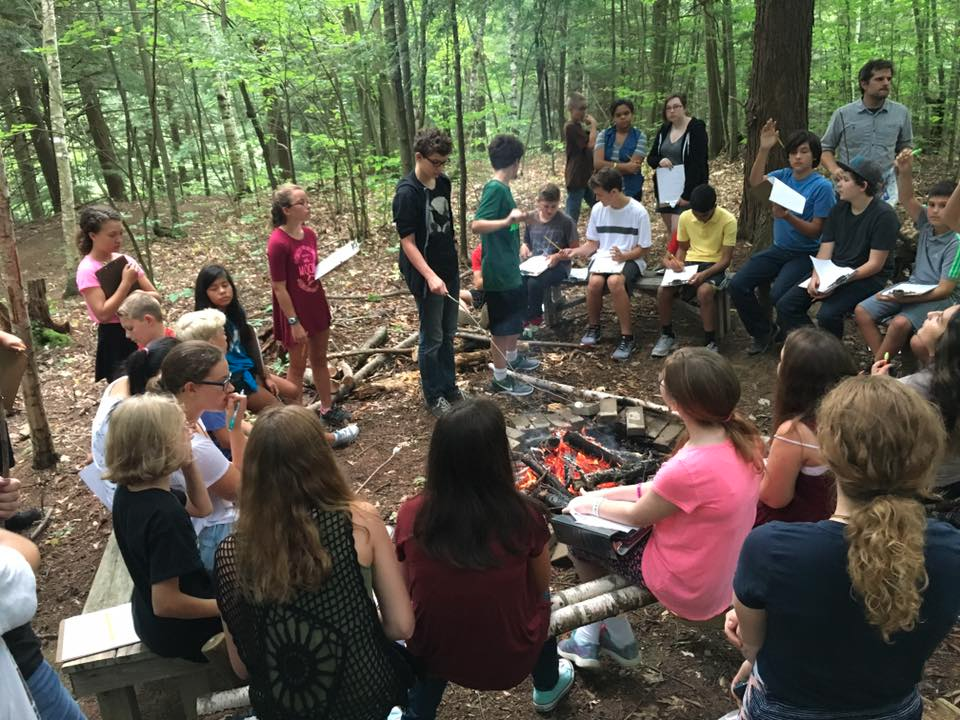
This was the question that launched our year together on the Edge Academy Team at Essex Middle School.  As our 7th and 8th grade learners worked to define this word, they came to realize that place is much more than the physical space.  It’s mostly about our relationships - with one another, with ourself and with the space itself.  Learners identified that when they think of place, they feel safe, supported and respected for their individuality.  We wanted to ensure that the learners on our team understood that “school” is not a physical space, but rather, learning can occur anywhere as long as one feels supported to ask questions and take creative risks.  With this in mind, we spent a large portion of our first day back at Essex Middle School outdoors and unplugged.  In small groups, we explored the ideas of diversity and perspective using a hula hoop outside on a field.  Careful observations were taken of everything found within the hula hoop.  We also asked learners to imagine what they would see if they dug one foot down and how their observations would change.  These observations were shared around a fire, as we discussed the ideas of diversity and perspective.  Marshmallows were roasted as we reflected on what kind of community we wanted to create this year.  Further activities on observation, perspective and diversity connected us to the book Zoom by Istvan Banyai.  This is a fantastic book to use for a variety of lessons on perspective!


Building Relationships.

Each morning, we meet as an advisory in our Circle of Power and Respect (CPR).  This is a given, every day you will walk into your advisory and the circle will always be there to start your day.  We use our (CPR) as a way to connect with one another, share, learn and strengthen our community.   Each learner found an object in nature that had some qualities that represented who they are as an individual.  


“There are three sides to every story: yours, theirs, and the truth.” - Chimamanda Ngozi Adichie

This object and the qualities were shared during our circle and a mobile, or centerpiece for our circle, was created with all of our individual objects.  The mobile is an important part of our CPR. It represents everyone in the circle as individuals and together, the power of our community.  It also serves as a place for focus for students when conversations become tough.   

Sharing Stories, Sharing Pancakes?

During the first month of school we focus intensely on exploring our identity.  We began our exploration of self by watching a TEDTalk by Chimamanda Ngozi Adichie on how she “found her authentic cultural voice. [She] warns that if we hear only a single story about another person or country, we risk a critical misunderstanding”.  This important message was enjoyed while eating homemade pancakes and our very own Edge Team maple syrup that we produced last spring in our sugarhouse.  This is one way to highlight past projects and the dynamics of our project-based learning model on our team.  

There are so many layers to our identities and in stories, we see ourselves, learn about our world and learn how to make our way in it.  Learners crafted the story of their names, as well as created identity maps.   We also have begun to explore the art of interviewing and listening.  Learners have been conducting interviews to capture the stories of September 11, 2001, from a trusted adult.  Through these experiences, they are developing the critical skills that will be necessary for their project work this year.  

Pushing Personalization Further.

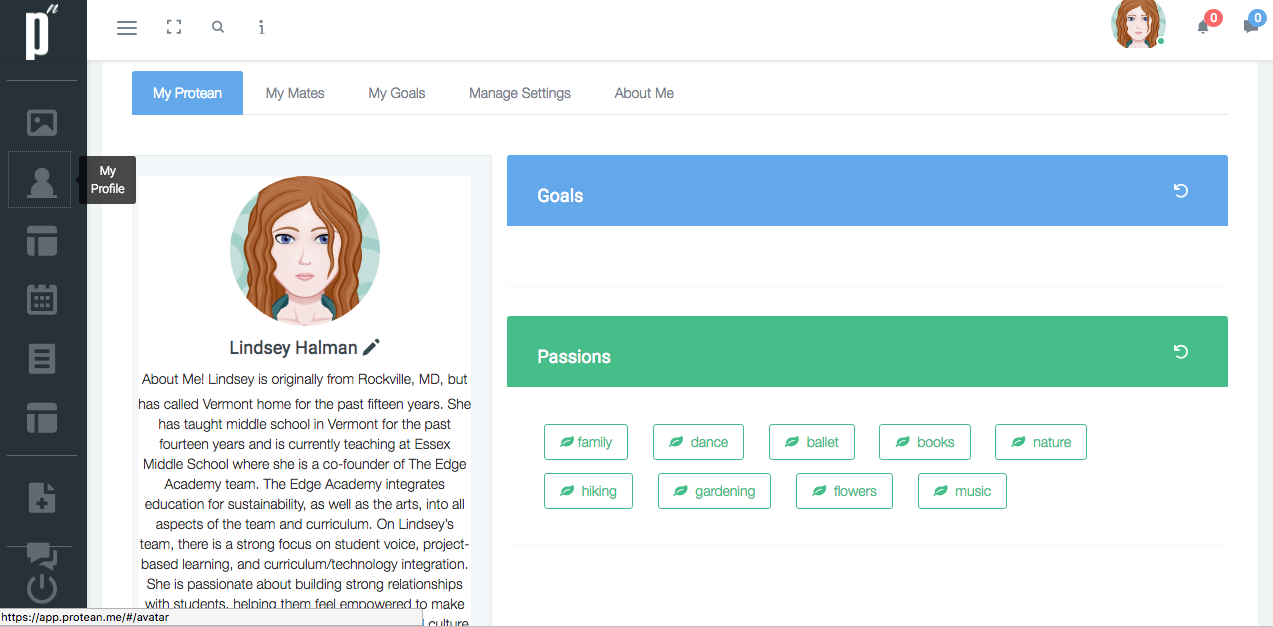
This year the students on the Edge Team, as well as other students at Essex Middle School will pilot Protean as our platform for their PLP.  We are excited to explore the potential of this dynamic platform.  Learners will use Protean to share who they are, what their goals are, and demonstrate proficiency with the Transferrable Skills in a truly personalized manner.  Within both traditional groups (classes) and non-traditional groups, learners will track their progress toward proficiency, document their learning and reflect on it.  We will share more as the year unfolds, but currently, learners have created their avatars and have started to create their bios and tag their passions.  
Screen Shot 2016-09-20 at 6.29.19 PM.png

Self Questions.jpgFlexible Pathways: Start with the questions!   We are always excited to try something new to push our work with our young adolescents further.  But, one thing that always remains at the heart of our team is our Negotiated Curriculum process.  Learners have been working on developing questions/concerns they have about themselves and the world.  In small groups, they are seeking commonalities and from there, extracting a possible theme for the year.  This year we will add a further dimension to our project work and challenge our learners to link their theme and their projects to the United Nations Sustainable Development Goals.  

Wednesday, September 7, 2016

Building a Learning Community

Over the next few weeks, we'll be featuring teachers throughout Vermont as they implement personal learning in their classrooms. Today's post is by Don Taylor of Main Street Middle School in Montpelier.

Across the state, teachers and students have spent the first few days of school establishing norms, getting to know their new students and creating positive learning communities. Working with the guidelines provided by Act 77, educators are venturing into new territory on three fronts: personalized learning, proficiency-based learning, and flexible pathways. The Middle Grades Collaborative and Tarrant Institute for Innovative Education have created a model for understanding these pillars of personalized learning in support of educators and students (see graphic).
Courtesy of the Middle Grades Collaborative


Team Summit at Main Street Middle School in Montpelier has focused the first few days of school developing scaffolded instruction aligned with the Personal Learning Framework. Students entering the Team Summit learning environment spent time framing their identity as individuals, students, and citizens (in real time and in the digital world) of the Team Summit community. This initial brainstorming will serve as the basis for the Identity section of student personal learning plans.

In a new development, Summit students were then asked to translate Vermont’s transferable skills into student-friendly language. Students ranked the skills in order of importance and in small groups, identified the ten most important behaviors reflected in those standards. Subsequently, students will vote on the top ten transferable skills and dispositions required for success on Team Summit. Those student-selected dispositions will then become our Team Summit Constitution.

As students continue to work through the Identity stage of the Personal Learning Framework, their understanding of the transferable skills will help them to develop initial goals. This scaffolding will allow us to begin the Growth and Reflection phase earlier than in years past. Additionally, working with the transferable skills in kid-friendly language facilitates the use of common language that can be used across personal and proficiency-based learning.


Student translation of transferable skills
Furthermore, by incorporating elements of personal learning and the PLP into the development of the learning community, teachers and students can begin building relationships based on student strengths, challenges, and goals. Building these relationships early can be a key factor in student and team success.

Thursday, January 28, 2016

Hazen Union: Linking PLPs, Identity, and the Community

Our incredible team of Hazen Union 7th and 8th grade teachers have been working collaboratively and intentionally over the past year to create opportunities for all students to feel empowered in addressing the mission of our middle level.  "The middle level years are important in building students' social and emotional skills, as well as developing their abilities to communicate, work with others, be creative, and problem solve. By instilling these skills in our young students we give them the opportunities to express themselves and explore their interests in order to prepare them for the next stage of their lives."


Our team gathered last summer at the Middle Grades Institute with a tremendous task at hand: create a sequence of learning that blends a community-focussed interdisciplinary unit, negotiated learning, personalized learning plans (PLPs), digital citizenship, and the rollout of our 1:1 iPad initiative.  With the support of Susan Hennessey and the Tarrant Institute for Innovative Education, our middle level team developed dynamic curriculum and experiences to begin and sustain through the school year.  


In addition to this work, we have worked hard at sharing our story.  The middle level has created a blog to reflect on a variety of experiences, to which teachers and students contribute.  Our school has begun podcasting, interviewing students and faculty on numerous subjects.  And most recently, we created a video (to be shared at the Middle Grades Conference) documenting our journey:


Great things are happening here at Hazen and it is only the beginning.  Our students have built strong foundations for their PLPs, engaged in meaningful ways with their school and town communities, and developed a rich understanding of their digital footprints.  As educators, we are continually amazed by the learning and work produced by our thoughtful and skilled students.  We look forward to a great second semester and the opportunity to reflect, refine, and revise the work we have started.  


(If you have any questions, please feel free to contact me at jcraig@ossu.org or on Twitter @OldManCraig.)

Wednesday, November 18, 2015

Core Values and the Personal Learning Framework

When looking at the Personal Learning Framework one of the key components to the Identity section is having students think about who they are and their core values. Ultimately, this can be a foundation to help students design goals.


For the past few years I have been trying to help my students think about their identity and develop a sense of self. However, I was finding that I always had a group of students who really struggled reflecting on themselves and communicating their values. Being an avid-skier, I had heard about something called the Flyin’ Ryan Hawks Foundation and felt it may fit this need in my classroom.


The Flyin Ryan Hawks Decision Program


Ryan Hawks was a well known freeskier out of Mad River Valley who went on to compete in the Freeride World Tour. Ryan passed away from injuries sustained at a Freeride World Tour event in Kirkwood, California. Shortly after Ryan’s passing, his family found a document on his computer where a few years before, Ryan had crafted his own core values.  The Flyin’ Ryan Hawks Foundation was established “with the idea of EXPOSING people to Ryan’s core principles, INSPIRING them to explore and compose their own set of core values, and ACTING on the core principles they have composed.”


Implementation at Peoples Academy Middle Level


Being personally inspired by the Flyin’ Ryan Hawks Foundation, I started to hear more and more about the Decisions Program the Foundation had started. This program brings Ryan’s Core Values into schools and organizations as a way for students to write their own core values.  I knew this would be a great fit for my students, especially those who had a hard time engaging in self reflective work.  I reached out to South Burlington High School teacher, John Painter, who had a Rowland Fellowship last year where part of his fellowship was to work with area school to implement the Decisions Program. After my meeting with Painter, I knew that the FRHF Decisions Program would be a great way to kick-off this year’s PLP roll out in September and I could not be more thrilled with how the project took off.


In the start of year year we introduced our students to the FRHF and Ryan’s core values through video on the Foundation's website. Students were instantly inspired by Ryan’s story. It is so important to give our students real life examples of things we ask them to do. Ryan not only thought about his core values, but also set goals and achieved many of them. This was a powerful way to engage our students to think critically about their own core values, which can be a very difficult exercise for 12 and 13 year olds.


Next, we had our students reflect on how others saw themselves. How would their family describe them? How would their friends describe the student? Finally, how would they want to be described?


This started our conversation with students about their core values; the qualities and characteristics they want to be have in their life that will guide them. As teachers, we also were crafting our own core values list and sharing them with the students. We asked students to come up with a minimum of four core values, but many went above and beyond those expectations.


Finally, we had students go into iMovie on their iPads and turn their core values into a movie that would become a part of their PLP. The iMovies included images and music of their choice as a way to highlight their personal core values.


Students were so engaged in this project, many of them worked on their videos at home and shared them with their parents and friends while they were still in the creation stage. Having students craft their core values in this way gave us great insight into what drives our students and who they hope to become. We used these core values to then launch into the PLP, looking at how their core values will guide them in their life and think about what goals can set to help stay on the right track.


Parents Reactions to Students Core Values iMovies

One of the most rewarding aspects of this project was the reaction parents had while viewing their students’ core values iMovies. We had students start their student led conference this year by showing their video which was placed on the About Me section of their PLP. You could see the joy on the parents’ faces while watching the videos. Many parents asked to watch the videos multiple times and asked thoughtful questions to their children about both the process and the values the students selected. We asked parents for feedback after the student led conference, and it was overwhelming how many parents commented on how nice it was to see their students’ core values iMovie.

For more information about bringing the Flyin’ Ryan Decisions Program to your school or classroom please contact John Painter at jpainter@sbschools.net.


Maura Kelly is a 7th grade humanities teacher at Peoples Academy Middle Level in Morrisville, Vermont. She has a passion for working with young adolescents and believes in the power of a strong middle level program in developing students to be ready to face challenges in our world today. When Maura is not teaching you can find her out skiing and biking around the state of Vermont.

Tuesday, September 15, 2015

Identity, PLPs, and the Learning Community

Personal learning plans can be an ideal platform for starting off the new year and getting to know the new students who have entered your learning community.

This year, after a brief primer on digital citizenship, students immediately began work on their Identity page. There are several huge benefits to teachers who initiate the personal learning process at the beginning of the year.

First, teachers can emphasize important elements of the 21st century classroom. These might include digital citizenship concepts related to putting our best digital footprint online to discussions of appropriate personal information and privacy. Teachers can use these "teachable moments" to set year-long expectations and classroom protocols for the use of technology.

Second, through observation and task selection, teachers can quickly identify the technical strengths and challenges that new learners bring to the learning community. Can't insert that image? Don't know how to label a file? Trying to crop a picture? Need help formatting the Google site or following instructions? These issues can help teachers zero in on the needs of their students. Down the road, each of these questions can be parlayed into skills work and lessons that will improve student performance (and can be evaluated using the Agency of Education's Transferable skills).

Third, and as a language arts teacher, perhaps most importantly, students provide teachers with a biography that can be evaluated as a norm/standards referenced writing piece. This highly motivating writing requires very little prior knowledge. After all, who do students know better than themselves? Yet the structure of their paragraph writing, ability to use the writing process, and finished product will give the instructor an immediate understanding of student writing ability.

At the end of the day, using personal learning plans to welcome students to your learning environment can be a highly effective, informative, and meaningful learning experience that can get your year off to a great start.