Showing posts with label communication. Show all posts

Friday, January 20, 2017

Practitioner Perspective: Weaving Goals, Reflection, and Transferable Skills into the Curriculum

This week's blog post is from regular contributor Lindsey Halman, founder and teacher on the Edge Academy Team in Essex.


Each Monday on the Edge Academy Team at Essex Middle School, we have a full team meeting, called Gathering Meeting.  This meeting serves a number of purposes - it builds community, it provides opportunities for youth leadership, it’s fun, and most importantly it is the opportunity to share the Edge Goals for the week.  These goals guide our work and provide our learners with a clear vision of what they can expect for the week.  

In order to ensure we support our learners in understanding what it means to have self-direction and communicate clearly and effectively, we ask that they share their weekly goals with a parent/guardian or trusted adult on Monday (see Link to Goals Memo Template) and write a reflective email to that same adult(s) on Friday (see Link to Weekly Reflection/Letter Template).  These opportunities allow us to ensure that there is clear communication between home and school and that our students are taking responsibility for their learning.


TEMPLATES:


Examples from Students:


VT Transferrable Skills:
Self Direction: Take initiative in, and responsibility for, learning.
Clear + Effective Communication: Demonstrate Organized and Purposeful Communication.


Notes on Goals
Deadline
Steps to Completion for the Due Date
Clear and Effective Communication
  • Share notes about goals with parents by end of Monday.
  • Filling out table.
  • Friday email home due Friday.
  • Share doc with parents on Monday.
  • Sharing follow up due Friday.
Future Projects
  • Develop two driving questions that will guide project work and research.
  • Share evidence on Protean
  • Due date: Friday 1/13
  • Listen in class about driving questions.
  • Develop quality driving questions.
  • Post evidence on Protean.
  • Due FRIDAY!
Civic and Social Responsibility
  • Field Trip on 1/13  Friday  (Patin Libre)
  • Watch video by 1/10 Tuesday be prepared for Humanities.
  • Flynn Teaching Artist on Thursday
  • Bring layers for Friday
  • Watch video about Patin Libre on own time before Tuesday afternoon.
  • Bring layers on Friday.
  • Possibly sign up to lead future gathering meetings.
PLP
  • Post evidence on Protean about one or more goals
  • Post on Protean 2 Humanities Goals.
  • Post 2 Driving Questions
  • Create a reflection
  • DUE FRIDAY.
  • Post the evidence about the various goals.
  • Write a reflection
  • DUE FRIDAY!
Humanities
  • Unit planning and Goal Setting Google Form DUE TUESDAY
  • Launch new unit
  • Choose new book groups
  • Flynn teaching artist
  • Fill out Google Form
  • Submission DUE TUESDAY
  • Prepare for performance on FRIDAY
Science
  • Windmill packet DUE FRIDAY
  • Detailed response paragraphs typed up on Google Docs
  • Fill out packet in math class.
  • Type up detailed response paragraphs.
  • DUE FRIDAY


****This week is PROJECT’S WEEK****
In order to meet my goals this week, I will….
Work hard, have perseverance, and  put in 100% effort
I might need support with…
Driving questions
Thanks for looking over my notes and I will inform you of my progress on Friday!


Examples of Friday Reflections - Weekly Letters Home

Dear Mom and Dad,

This week has been a successful week for me because I completed all of my weekly goals. For the Edge weekly goals, I completed everything except the posting of evidence to Protean (Which I am about to do as soon as I finish this letter.) I created my two driving questions for my yearly project this week. My project goal for next week is to really get into the research and take a lot of notes. In Physical Education, we got split into two groups : Basketball and Weightlifting. I, fortunately, got put in the group that starts with weightlifting. One highlight from the week was the fact that we started a new unit in Humanities and we are going to have book groups. I am really excited to know which book I will be reading. One goal for next week is to get a good grade on my algebra midterms.
Sincerely,
Jessy

Dear family,
              
                    This week has been a fun week for me. We finished our windmill task which was great to learn the engineering design process and how to build things on Tuesday we heard a speech from a teacher that went to Cuba she told us about the way they live and how it is very hard to try to make it to america and how different are schools are. In projects we are creating driving questions for our future projects. My highlight of the week was today we went to go see Le Patin Libre, they are a ice dancing group that defies ice dancing stereotype this show was very unique and I'm glad that I got to experience it. My goal for next week is to learn something I never knew before.

 Sincerely, Natasha

Dear Mom and Dad,

This week has been pretty busy, with Paige and I making our flan and going to Micaela's to work on projects. This week we also worked on writing our driving questions to help lead our project research. After finishing those, Micaela and I used a directory of LGBTQ staff at UVM (given to us by someone who visited the Edge team named Erin) to find some possible people to interview for our book. We can hopefully start drafting next week. Something else we'd like to do is meet up after school on as many Wednesdays as possible to get some extra work done.

In DTE, we've finally finished constructing our car and we've timed it on the track. It made it to the other end in about 10 seconds, and we're working to make it go faster.

In Spanish, our flan went great! Some people found it too sweet for their liking, but Senora Psaros said it was perfect. I also feel like the presentation in itself went well.

Ms. Wager (she does lessons for the woodwinds) gathered everyone in districts to practice yesterday.

One highlight from this week was making the flan with Paige. That was fun.

One goal for next week is to set up some meeting dates to interview at least one of the people that responded to the emails Micaela and I set up. We'd have to get some help from Phil and Lindsey to do that, though, and we'd also have to create some questions.

See you later!
M


Tuesday, September 13, 2016

Getting the Ball Rolling with Personalization and Proficiencies

This week we will be featuring a post authored by Kevin Hunt, a PLP Pathways contributing author, participating PLP Pathways webinar moderator,  and teacher in the Swift House, Williston Central School.

The school year is officially under way and we are in full swing! As in previous years, Swift House has front loaded the beginning of the school year with team building and identity work for our PLPs. Our new 5th grade students on our 5th-8th grade team have already done some great thinking about who they are as learners. We established five transferable skill goals with each of our new students and they had an opportunity to ask questions and receive some insider tips from their 7th and 8th grade mentors during our annual mentor/mentee breakfast before the start of the school year. It always strikes me how poised and articulate 7th and 8th graders can be when I hear them explain some of the finer nuances of our various systems on Swift House.

Identity work

The first few school days are loaded with cooperative games, ice breakers, and personal reflection. Between all of the chaos of seeing old friends, meeting new ones, and figuring out where the next class will be, we ask our students to take some time and reflect on who they are. We try to create a new activity for this every year to help engage all of our students. This year, we decided to create “Swiftagram” pages, since so many of our students are familiar--and somewhat obsessed-- with Instagram. We like to keep this first activity light and enjoyable. This is an opportunity for our students to think about the things that make them special and unique and also start exploring what they are most excited about for the coming school year.

We do our best to make sure all of our work has meaning, is relevant, and can help inform future decisions. The Swiftagram pages act as an informal gateway for our students to begin their identity work in our PLP framework. What may seem like a fun and somewhat trivial assignment of drawing pictures of things you like and commenting on what excites you about school, is actually an assignment that carries a great deal of weight; these middle school students begin to recognize and think about who they are as unique individuals and as learners. This work typically excites students and we harness this excitement for personalization as we move forward in the school year.

There is a seamless transition from the informal identity work of  Swiftagram pages to the work that ultimately is uploaded to the identity section of the PLP. We ask that students create a brief autobiography for their identity page. We present this work as a core (our lingo for homeroom) journal. We are intentional in instructing students to present this information in a format of their choosing. We’ve found that limiting students to a specific medium such as writing has a detrimental impact on their ability to produce a meaningful autobiography. There are so many tools and resources with technology that allow all students to let their voices be heard. We try to access and utilize these to create personalized opportunities whenever we can.

Communication

Communication and transparency are key ingredients for a good start to any school year. As educators, we commit hours over the summer and during professional development days to learn about and gain mastery in the newest initiatives that our state and districts have to offer. Now that ACT 77 is in full swing, the focus in our district has centered around proficiency based learning (PBL) and the nuts and bolts that come with it: assessment, reporting, and implementation. The teachers have gained insight and tools to ready themselves for the start of the school year. The next piece of this puzzle is to communicate this learning--and in some cases, paradigm shift--with parents and community members.

Swift House is in an interesting situation as it has been using a version of proficiency-based learning for some twenty-five years. We  started our school year with a similar approach to what we have done in the past: summer mailing  to new 5th grade families and returning 6th-8th grade families, hopes and dreams conferences, mentor/mentee breakfast, team building, and identity work for our PLPs. Since our returning students have already been exposed to our system with proficiencies and PLPs, we utilize this time before the start of the school year to not only make our new 5th grade students feel welcome, but also inform them and their families about our process.

During our hopes and dreams conferences, parents and students are asked to bring in a student profile sheet that we sent out in our summer mailing. This profile sheet outlines the student’s strengths and challenges within various transferable skills categories and most importantly, provides insight about the student’s likes, dislikes, hobbies, and interests. This is an important part of our process as the student is given a voice and opportunity to advocate for him or herself from the very first conference, which helps later on in the year with our student-led conferences. We use this opportunity to learn about the whole student and also engage them with the goal setting process, while introducing them to the transferable skills. We work together as a PLP team (student, teacher, guardian) to create meaningful goals for each of the transferable skill categories. This is often the time when parents will ask about our grading policies as well. We’ve found that taking the time in this first conference to talk face-to-face and explain our philosophy around proficiency-based learning has had a profound impact on how the rest of the year (and subsequent years) will go. Once parents and students are introduced to our system from that first meeting and understand our expectation and teaching philosophy, there are seldom any questions or complaints to follow.

Since our entire district has completely moved to PBL, there has been a greater volume of information going home to all parents about the shift, which in turn has brought up more questions about PBL than we have had in the past. Though we haven’t had to make any philosophical changes to our practice on Swift House, it has provided an opportunity for us to take a step back and reflect on not only how we are using PBL, but why we do it. On a professional level, this has also become inspiring work to both share with other educators and learn what others think about PBL and how they are implementing it. Just recently, we adopted a ‘crash course to PBL’ document that was created by a group of progressive teachers in Shelburne Community School. As the Swift House teachers revised the original document to fit our team, it sparked thoughtful and productive conversation amongst us, especially regarding communication and transparency with parents.

As the state continues to shift towards proficiency based grade requirements, it is so important that we are being as open with communication as we can with parents. Though there can be a sense of dissonance between this work and the traditional system that so many are used to, it’s important to keep in mind that payoff that this has for student learning and investment.

Monday, February 15, 2016

Swift House: PLP History Part 3

This week we will be featuring the final installment in a series of blog posts from Kevin Hunt, a contributor to PLP Pathways and teacher in the Swift House, Williston Central School. 

PLP Pathways encourages contributions from teachers and educators across the state who are implementing personalized learning or, like Kevin, have integrated it into their programs. This week, Kevin discusses the process for linking goals and evidence, communications with parents, and student-led conferences.

[Swift House] students also have an opportunity to input evidence to their various goal pages. For every piece of evidence that they embed, whether it be a document, presentation, video, or image, the students need to include a couple of sentences on how each piece of evidence directly relates back to their goals. This process of having students write about how their evidence connects to their goals both assures that the evidence they are including has relevance for that specific goal page, and it gives the students another opportunity to reflect and notice the progress that they have made toward reaching their goal. This wouldn’t be as fluid of a process if we did not have flexible scheduling and a house-based team structure. We all are generalists who teach the same content at the same times during the school day. The fact that there are pockets of time within our schedule that we have our entire [Swift] student body present, allows us to make changes to our schedule as needed.


In each core class, we also pair 5th grade students with mentor 7th and 8th grade students. These mentor/mentee pairs are created before the beginning of the school year and the mentors have an opportunity to meet their mentees before the first day of school to introduce themselves and give them some advice from a student’s perspective. We often utilize our mentors during PLP time. Our 7th and 8th grade students, who have already had two-to-three years of experience with our PLP process, work with their mentees to assist them in finding evidence and linking work to their portfolios.


By the end of each trimester, students have at minimum four pieces of evidence (with connections) for each goal, a goal reflection, which states the importance of the goal, successes with meeting the goal, challenges, and next steps, and their various class reports. These pieces are all outlined in their PLP checklist and are reviewed during their student-led parent-student-teacher conferences.


NE PLP.png

Parent Involvement = Greensheets (Friday Sheets)


Students on Swift House complete a weekly Friday sheet that acts as a communication tool between school and home. Students receive these Friday sheets on Thursday and are required to get either an initial from their teachers of their various classes or a circle. An initial represents that students are caught up with all work and have nothing overdue. If a teacher puts a circle next to the class, that indicates that the student owes either classwork or homework, and the teacher will indicate and write down what is owed. Students bring home the Friday sheets over the weekend and bring them back, with a signature from their parents, by Monday. The parents also have an area to initial that indicates that they have taken the time to review their son or daughter’s PLP weekly goal reflection and evidence. This weekly communication assures us that our students parents are being kept in the loop regarding their child’s weekly progress, as well as let us know that they have taken the time to review their child’s PLP, or at the very least acknowledge its existence.


Student-led Conferences


At the end of each trimester, teachers conference with students and parents to review their PLP progress and go over their class reports. These conferences typically last thirty to forty-five minutes and are led by the students. Students spend the majority of time showing their online portfolio, which houses their various PLP goals and evidences. After each goal is reviewed, the PLP team has a conversation about the student’s progress and discusses whether or not the student would like to keep the goal, tweak the goal, or change the goal completely. This provides a wonderful opportunity to students to advocate for themselves and take full control over their learning.

Monday, February 8, 2016

Swift House PLP History: Part 2

This week we will be featuring the second in a series of blog posts from Kevin Hunt, a contributor to PLP Pathways and teacher in the Swift House, Williston Central School. PLP Pathways encourages contributions from teachers and educators across the state who are implementing personalized learning or, like Kevin, have integrated it into their programs. This week, Kevin discusses the process for selecting and reflecting on evidence as part of the PLP process.

Portfolio and Reflection


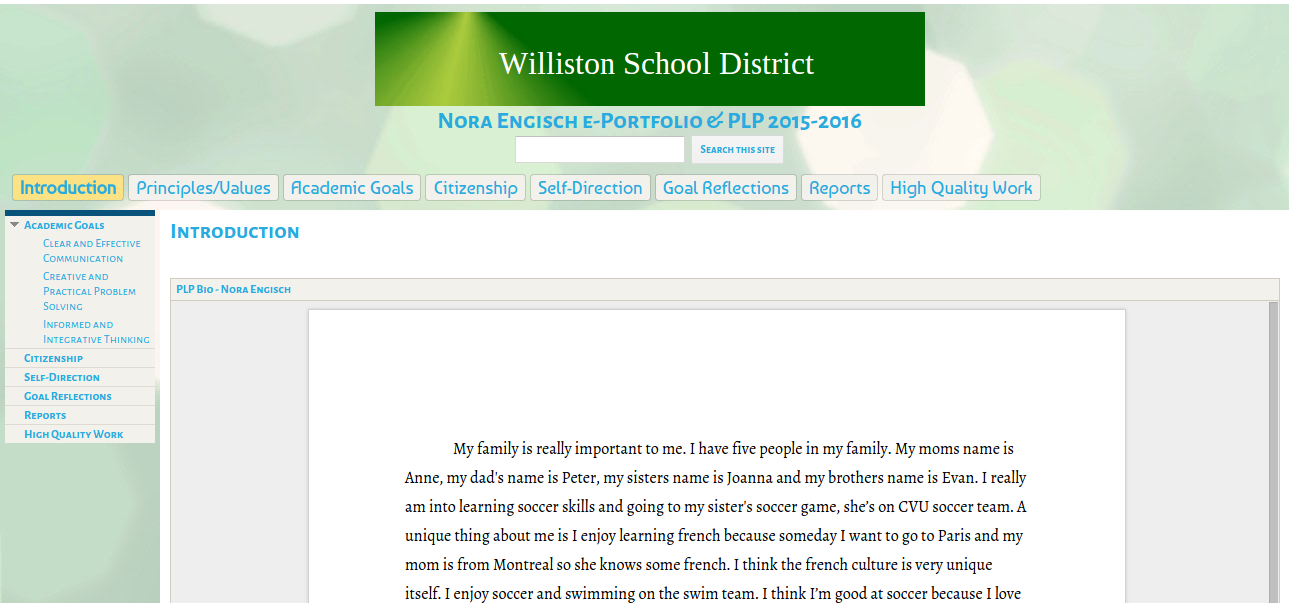
We use Google Sites as a platform for our online portfolio/PLP. The portfolio acts as the ‘medium’ that houses the PLP, which includes the ‘process.’ Each core teacher (there are four core teachers with roughly one-hundred students divided into the four core classrooms) creates an online roster for his or her core class and uses the add-on Site Maestro to blast out the e-Portfolio template that we use. Using Site Maestro allows us to keep a record and have quick accessibility to all of our core students’ PLPs as well as add bulk collaborators if needed (ie. other teachers, guidance counselors, etc.).


Once the students receive the template, they have the option to personalize their background and font. As a personal learning plan, we want the students to have as much say and control over the process as possible. They add their goals to the various tabs and under the “Goal Reflections” tab, they create a table, indicating what their five goals are. The Goal Reflection page is created as an ‘announcement page’ (mini blog), so students can have an ongoing record of their goal reflections, which occur on a weekly basis.


We have built in a thirty minute block of time each week within our core (homeroom/advisory) class for students to work on their PLPs. During this time, students write a blurb in their goal reflections page, in which they provide input on progress they’ve made on their various goals that week, or if they haven’t made progress, they write what their next steps should be. This process keeps the students reflecting on a regular basis and creates a sense of accountability to commit to working on or at very least thinking about their goals.

Tuesday, January 19, 2016

Using Labels In Blogger To Support Evidence and Reflection

Returning to school after the winter break, I always feel that I need to refocus my students on their evidence and goal reflections.. At this point in the year they have been working on their goals for enough time to do a larger self-assessment and think about adjusting their goals based on the evidence that they have been collecting.

One of the large challenges of doing this is trying to figure out what system to use with students that allows them one place to put all of their reflection and evidence. It also needs to be easy to use and easy to organize so they can find their evidence to put on the PLP.  At Peoples Academy Middle Level, all of our teams use Blogger. Paired with the use of labels, it has allows students the ability to reflect on their learning throughout the day in one organized place.

With the addition of labels on the blog, students can tag their posts so they will have easy access to evidence demonstrating  growth towards  their goals. Labels also allow students to put multiple labels on one post, allowing students to track goals and growth in all subject areas. Please see an example student blog on the PLP Pathways site.


Maura Kelly is a 7th grade humanities teacher at Peoples Academy Middle Level in Morrisville, Vermont. She has a passion for working with young adolescents and believes in the power of a strong middle level program in developing students to be ready to face challenges in our world today. When Maura is not teaching you can find her out skiing and biking around the state of Vermont.

Wednesday, October 14, 2015

PLPs and Parent Communications


PLPs and Parent Communications

Late September and early October bring leaf-peepers, spectacular fall foliage, and hopefully, some rhythm to the school year. Among all the activity, and depending on school implementation of personal learning plans, teachers may be considering how to best communicate their work with PLPs to parents and the community.


Parent and educator involvement in the PLP process, including easy access to, and monitoring of the PLP plan, are critical elements of Vermont's Personalized Learning Program. Here are some options to consider when thinking about introducing the PLP process to the community.

Parent Education and Planning

Developing a plan for reaching out and communicating teacher, team, and school plans about the implementation of PLPs can significantly improve parent understanding  of the process and expectations for student work.

To make this successful, teams and teachers should look at the calendar and develop a process for distributing information in a meaningful and cohesive manner. Calendar dates should also be given consideration as events such as Open House and student-teacher conferences can be excellent opportunities to keep parents and the community informed about PLP implementation and what that means for their students.

Educational resources and information for communicating to parents are widely available through the Agency of Education's Vermont PLP Process website. You can also find information on the PLP Pathways web page.

Electronic and Social Media

Depending on teacher and team social media presence, popular platforms such as Twitter, Instagram, and Google+ can be excellent venues for the distribution of PLP related material. Individual, team, or school websites can also be great places to distribute links and material to the community.

Obviously, this requires an understanding of the community's use of technology (and perhaps additional education). That said, these tools can be excellent for supporting implementation of the personalized learning program.

PLP Based Parent Conferences

Conference formats and expectations vary widely from school to school but utilizing the PLP as a foundation for student-parent-teacher conferences can be a great way to introduce parents to the PLP program. This option requires thoughtful planning and clear expectations for all parties.

Here are some thoughts to consider:

  • What elements of the PLP will be viewed or discussed in the conference?
  • What role will the student play -- leading the conference, participant, presenter?
  • What advance preparation is necessary so that students and parents can move through the conference format without confusion or questions?
  • What goals and evidence do students need to have on their PLP to most accurately reflect their academic achievement, social growth, and strengths and challenges?
  • How can the conference be formatted to maximize parent understanding of both the PLP process and student progress?
  • How will teams and teachers document parent involvement in the PLP development process?
  • How will teachers and teams develop feedback systems to identify elements of the conference experience that need improvement?

Admittedly, this is a lot of work and it requires a good deal of planning and preparation. Teams and teachers in the first year of implementation may choose to simply introduce the PLP process to parents at conferences.

Summary

Efforts to educate parents and the community about Act 77 and Personalized Learning Plans can help teachers, teams, and schools develop support for these educational initiatives. By planning ahead, utilizing existing structures where possible, and through the thoughtful implementation of new media and technology, educators can ease the transition to the personalized learning model.