Showing posts with label technology. Show all posts

Wednesday, April 6, 2016

PLP Collaboration at PAML

Here at Peoples Academy Middle Level, we were fortunate to have two professional development days over the past month and a half. One of components of our work during the professional development time was meeting in vertical teams to discuss the implementation of portfolios and proficiency based learning. This time proved to be greatly valuable -- all of the teachers came away with deeper understandings that will impact our practice.

At our meetings, the 5th grade team identified a key challenge to implementing portfolios; the struggle students have with setting goals.  Fifth grade teachers  were finding that some students were having a hard time identifying a goal, or they were creating goals that we not realistic, relevant or connected to the transferable skills. Knowing that our lower middle level students enjoy partnering with upper level students, we decided to have our 7th grade students collaborate with the 5th graders on their goals work.

To make this successful for all students, we had the 5th grade students start with a goal setting template so that they would arrive at their goal setting meeting with 7th grade students sharing some ideas around a goal. At the same time, we had our 7th grade students look at a SMART goals template, similar to what the 5th graders were using, and try to develop questions to help guide the 5th grade students.
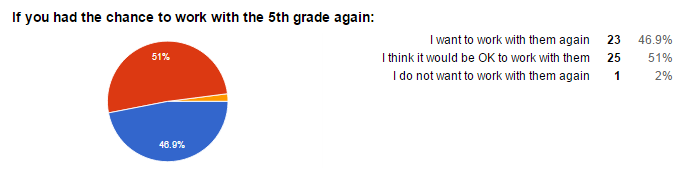

After giving students time to prepare, we set up an hour block of time where our 5th and 7th grade students would meet with a goal partner. Students were reminded of expectations and then got right to work. The 5th grade students introduced their ideas for their goals and the 7th grade students acted as guides and facilitators. Many 7th grade students shared their own PLP sites, experiences, successes and challenges as a way to help guide the 5th grade students. Once the partnership reached a point that they felt the goal was a SMART goal, they collaborated on a Keynote that will go on the 5th grade PLP in preparation for student led conference that they will present in the spring. In thinking about next year, we have hopes of building a robust PLP mentoring program as a way for multi-age collaboration and support to occur with the PLP.


Here are some of the thoughts of our 7th grade students on their experience of helping the younger students:

“Being able to teach them the knowledge you have, feeling important to their learning.”

“Getting to that moment when they finally understand what you're saying, and they start cooperating with you.”

Helping the 5th grade students helped me to:

“It made me think about how my goals related to own my life and how I could improve upon my goals, as well as help them improve on their goals.”

“It helped me think of what I needed to change on my goal.”

“It helped me take a reality check on my goals.”


Wednesday, December 23, 2015

PLP Pathways Year in Review

The PLP Pathways project was started as an effort to support the work being done on elements of Act 77 by teachers around the state of Vermont. With support from the Middle Grades Collaborative and the Tarrant Institute for Innovative Education, we have focused on the implementation of personal learning plans with an emphasis on the middle level.

The premise of the website and supporting social media is that by developing a collaborative and cooperative workspace for teachers, the transition and implementation to personal learning plans will be more efficient. In particular, we hope to provide "real world" examples of teachers around the state who are leading their students and colleagues in these new initiatives.

Moreover, instead of providing stand alone professional development, we are trying to provide a continuous arc of instruction and resources that will be relevant throughout the personal learning plan implementation process.

What have we learned thus far?

  • There are teachers across the state doing amazing work  with personalized learning that demonstrates creativity, professionalism, and outstanding educational practice.

  • Using Google Blogger as a reflection tool with students can be a tremendous asset for developing student understanding of personal learning activities.

  • Time is extremely tight. Teachers are under a lot of pressure in the classroom and finding the time to participate in extra-curricular professional development can be tough.

  • Despite the time crunch, engaging in these professional development activities can have immediate and positive impacts in the classroom. Over the course of the past few months, suggestions from professional development activities and conversations have had a direct impact on our teaching practice and philosophy regarding the personal learning plans.

  • Google Hangouts and associated technologies, including Twitter and Google+ can be great ways of sharing, archiving, and curating excellent ideas for later classroom use.

  • As teachers roll out personal learning plans, collecting data regarding student attitudes and dispositions (using Google Forms) is critical.

  • Teachers should consider developing their own personal development plan. The practice of creating such a plan can provide invaluable insight into the student experience.

  • Developing effective communication strategies for families and the community is essential.

If you would like to learn more about these efforts, or just want to keep up to speed with personalized learning, please consider following us at PLP Pathways on Google+, through Twitter, or by subscribing to this blog. We'd love to hear about your experiences.  

As we head into 2016, we are excited about the continued evolution of personalized learning in Vermont, the challenge of supporting teachers with effective professional development, and mastering new technologies to facilitate collaboration, collegiality, and innovation.

A special thank you to Maura Kelly of People's Academy for her role as the PLP Pathways webinar and television co-host. Additionally, thanks and appreciation to Kevin Hunt of the Williston Central School, Megan Gagne of Colchester High School, Life Legeros of the Tarrant Institute, and Dr. James Nagle of St. Michael's College for their willingness to join our monthly webinars and share their expertise and support.

Finally, without Adam Blair's editing and ORCA Media's support, none of our video production would be possible. Thank you everyone and have a wonderful holiday break. We will see you at the Personalized Learning  in the Middle Grades Conference on January 9, 2016!


Tuesday, December 8, 2015

Using Data to Inform the PLP Process

Introduction

With the ubiquity of easy-to-use data collection tools available online, educators implementing personal learning plan programs this fall may want to consider systematizing their data collection efforts. This nuts and bolts organization can help teachers and students evaluate the direction of the program, develop essential feedback loops, and help complete the communication loop created with parents and the community.

Tools and Techniques

In our program, we leverage the ease of Google Forms to gather regular feedback from students regarding the elements of their personal learning plans, effectiveness of the initiative, and student dispositions regarding the personalization of the learning experience.

Educators and teams should spend some time deciding what information they would like to capture and at what intervals they would like to collect data. By setting up regular, consistent calendar dates for collecting feedback, teachers can design a system that not only informs current practice, but provides feedback over time, thus guiding the overall direction of the program. Standardizing questions throughout this process can help teachers identify strengths and challenges in the program.

One note on collecting data (and perhaps an obvious one); make sure that you have an effective labeling system for your data collection. Once your data set becomes more robust, wading through similarly labeled files can create confusion and eat up large amounts of time. Additionally, if you are interested in studying specific cohorts over time, specific labels will help organize your work.

Feedback, Student Input and the Learning Community

A critical element of collecting data regarding implementation of personal learning programs is the discussion and analysis of that data with students. Sharing the collected data (scrubbed of confidential or personal information) can be a huge benefit to teachers and students.

First, it provides students with the broader classroom perspective of the initiative. This can help students understand their role in the classroom community and also how their opinion and input can help shape the direction of that community. Second, data analysis and reflection can be an excellent platform for utilizing and teaching the transferable skills, particularly in areas of communication, collaboration, and use of technology. Finally, communicating data and analysis back to community members and families (some of whom may have participated in data collection activities) can keep them informed about their student's progress and is an important piece of Act 77 and the personal learning plan initiative.

Reflection

Finally, and crucially, collecting data in an organized manner is an essential element of student and teacher reflection. Collectively analyzing data can provide students with the evidence upon which they can begin reflecting on the personalization of their education. By thoughtfully considering not only their own responses, but also those of the learning community, students can be encouraged to reflect on their role in that community, their goals as a student and learning community member, and how they can participate in a more personalized educational future.

For teachers, reflecting on the data from personalization initiatives can be the stepping stone to transformative teaching practices. Students are our most valuable, most important, and most responsive constituents. By utilizing their feedback in an organized way, reflective teachers can leverage that information into real classroom change that engages, motivates, and inspires children through an effective personal learning experience.

Tuesday, September 15, 2015

Identity, PLPs, and the Learning Community

Personal learning plans can be an ideal platform for starting off the new year and getting to know the new students who have entered your learning community.

This year, after a brief primer on digital citizenship, students immediately began work on their Identity page. There are several huge benefits to teachers who initiate the personal learning process at the beginning of the year.

First, teachers can emphasize important elements of the 21st century classroom. These might include digital citizenship concepts related to putting our best digital footprint online to discussions of appropriate personal information and privacy. Teachers can use these "teachable moments" to set year-long expectations and classroom protocols for the use of technology.

Second, through observation and task selection, teachers can quickly identify the technical strengths and challenges that new learners bring to the learning community. Can't insert that image? Don't know how to label a file? Trying to crop a picture? Need help formatting the Google site or following instructions? These issues can help teachers zero in on the needs of their students. Down the road, each of these questions can be parlayed into skills work and lessons that will improve student performance (and can be evaluated using the Agency of Education's Transferable skills).

Third, and as a language arts teacher, perhaps most importantly, students provide teachers with a biography that can be evaluated as a norm/standards referenced writing piece. This highly motivating writing requires very little prior knowledge. After all, who do students know better than themselves? Yet the structure of their paragraph writing, ability to use the writing process, and finished product will give the instructor an immediate understanding of student writing ability.

At the end of the day, using personal learning plans to welcome students to your learning environment can be a highly effective, informative, and meaningful learning experience that can get your year off to a great start.