Showing posts with label plp planning. Show all posts

Wednesday, September 7, 2016

Building a Learning Community

Over the next few weeks, we'll be featuring teachers throughout Vermont as they implement personal learning in their classrooms. Today's post is by Don Taylor of Main Street Middle School in Montpelier.

Across the state, teachers and students have spent the first few days of school establishing norms, getting to know their new students and creating positive learning communities. Working with the guidelines provided by Act 77, educators are venturing into new territory on three fronts: personalized learning, proficiency-based learning, and flexible pathways. The Middle Grades Collaborative and Tarrant Institute for Innovative Education have created a model for understanding these pillars of personalized learning in support of educators and students (see graphic).
Courtesy of the Middle Grades Collaborative


Team Summit at Main Street Middle School in Montpelier has focused the first few days of school developing scaffolded instruction aligned with the Personal Learning Framework. Students entering the Team Summit learning environment spent time framing their identity as individuals, students, and citizens (in real time and in the digital world) of the Team Summit community. This initial brainstorming will serve as the basis for the Identity section of student personal learning plans.

In a new development, Summit students were then asked to translate Vermont’s transferable skills into student-friendly language. Students ranked the skills in order of importance and in small groups, identified the ten most important behaviors reflected in those standards. Subsequently, students will vote on the top ten transferable skills and dispositions required for success on Team Summit. Those student-selected dispositions will then become our Team Summit Constitution.

As students continue to work through the Identity stage of the Personal Learning Framework, their understanding of the transferable skills will help them to develop initial goals. This scaffolding will allow us to begin the Growth and Reflection phase earlier than in years past. Additionally, working with the transferable skills in kid-friendly language facilitates the use of common language that can be used across personal and proficiency-based learning.


Student translation of transferable skills
Furthermore, by incorporating elements of personal learning and the PLP into the development of the learning community, teachers and students can begin building relationships based on student strengths, challenges, and goals. Building these relationships early can be a key factor in student and team success.

Tuesday, May 10, 2016

Integrating Personal Learning Plans Into Practice

At this point in the year, you've probably had some experience either 1) implementing personal learning plans in your classroom, 2) planning for PLP implementation, or 3) hearing about personal learning plans through your professional learning networks.


Assuming this is the case, let's consider four ideas that might broaden the conversation and the possibilities of personal learning plans as transformative learning tools for teachers and students.


Principles of the PLP Become Principles of Your Curriculum


On Team Summit, we're using a PLP template that incorporates seven elements of learning that we consider to be essential for middle level students.


Screen Shot 2016-05-10 at 9.16.50 PM.pngThose seven are: Identity, Community, Principles and Values, Goals, Citizenship, Evidence, and Exploration. 

Each of those elements is given space within the PLP for students to demonstrate growth and learning within the context of that element.


For example, as students build knowledge and reflect on the meaning of citizenship, why not connect that to key ideas in the curriculum? For example, how did the idea of citizenship shape the Greek civilization? What does it mean to be an "active citizen" in Vermont? How are themes of citizenship woven into your classroom?


By connecting these key ideas from the personal learning plan to classroom curriculum and practice, teachers can build greater student understanding and connection to learning.


Mentoring Programs To Build Transferable and Citizenship Skills


Schools with multiple grades can incorporate student expertise with personal learning plans and associated technology into semi-formal and formal mentoring programs. Eighth graders, having years of experience with PLPs, can easily transition into leadership and teaching roles that support younger students as they create their own learning plans. 

Mentoring programs allow students to develop better understanding of their own skills and create opportunities for leadership and citizenship within the building. As a result, equity of opportunity for all students can be created without leaving the school.


Use The Personal Learning Framework as a Narrative Structure

Screen Shot 2016-03-20 at 7.49.35 PM.png
To guide students through a personal learning experience, students are asked to use the Personal Learning Framework to identify their progress through the program. In addition to helping students understand the different elements of the PLP (see above), the Personal Learning Framework provides students with guiding questions to help evaluate their growth and learning.


As an auxiliary exercise, students can explore their movement through the Personal Learning Framework in a narrative structure. The first part of their story can be the character development (Identity), the rising action and conflicts can be the strengths and challenges exhibited through the Growth and Learning stage, and the resolution can be a modified Transformation. Drawing on their real-life experience, students can use the Personal Learning Framework to craft their unique story.


The PLP As A Technological Maker Space


Google Sites may not be the most aesthetically pleasing or easily constructed PLP platform, but once students have the basic template, they can begin constructing or “making” their PLP into a custom online platform that reflects their academic and technological growth.

Just as students are “making” in computer labs, “making” with 3D printers, and “making” with game-based modeling, these same concepts of student-led construction can be applied to Google Sites. Creativity, graphic design, and unique elements of website construction can help students learn and demonstrate a variety of tech-based skills.

Wednesday, April 6, 2016

PLP Collaboration at PAML

Here at Peoples Academy Middle Level, we were fortunate to have two professional development days over the past month and a half. One of components of our work during the professional development time was meeting in vertical teams to discuss the implementation of portfolios and proficiency based learning. This time proved to be greatly valuable -- all of the teachers came away with deeper understandings that will impact our practice.

At our meetings, the 5th grade team identified a key challenge to implementing portfolios; the struggle students have with setting goals.  Fifth grade teachers  were finding that some students were having a hard time identifying a goal, or they were creating goals that we not realistic, relevant or connected to the transferable skills. Knowing that our lower middle level students enjoy partnering with upper level students, we decided to have our 7th grade students collaborate with the 5th graders on their goals work.

To make this successful for all students, we had the 5th grade students start with a goal setting template so that they would arrive at their goal setting meeting with 7th grade students sharing some ideas around a goal. At the same time, we had our 7th grade students look at a SMART goals template, similar to what the 5th graders were using, and try to develop questions to help guide the 5th grade students.


After giving students time to prepare, we set up an hour block of time where our 5th and 7th grade students would meet with a goal partner. Students were reminded of expectations and then got right to work. The 5th grade students introduced their ideas for their goals and the 7th grade students acted as guides and facilitators. Many 7th grade students shared their own PLP sites, experiences, successes and challenges as a way to help guide the 5th grade students. Once the partnership reached a point that they felt the goal was a SMART goal, they collaborated on a Keynote that will go on the 5th grade PLP in preparation for student led conference that they will present in the spring. In thinking about next year, we have hopes of building a robust PLP mentoring program as a way for multi-age collaboration and support to occur with the PLP.


Here are some of the thoughts of our 7th grade students on their experience of helping the younger students:

“Being able to teach them the knowledge you have, feeling important to their learning.”

“Getting to that moment when they finally understand what you're saying, and they start cooperating with you.”

Helping the 5th grade students helped me to:

“It made me think about how my goals related to own my life and how I could improve upon my goals, as well as help them improve on their goals.”

“It helped me think of what I needed to change on my goal.”

“It helped me take a reality check on my goals.”


Wednesday, March 23, 2016

Sterling House Implements PLPs

This blog was co-authored by Joy Peterson and Jared Bailey. Joy and Jared are teammates on Sterling House at Williston Central School. Joy is the ELA teacher and Jared is the math teacher.


Act 77 requires students to develop a PLP starting in grade 7. Here on Sterling House at Williston Central School, we are 5/6 interdisciplinary team. In the fall, we began to explore PLPs at a faculty meeting in which Don Taylor presented his PLP work to us.  


While Act 77 does not impact us directly, we took the view that we could begin to prepare our students now, by implementing PLPs in 5th and 6th grade, and help them to be familiar with the process when they reach 7th grade.


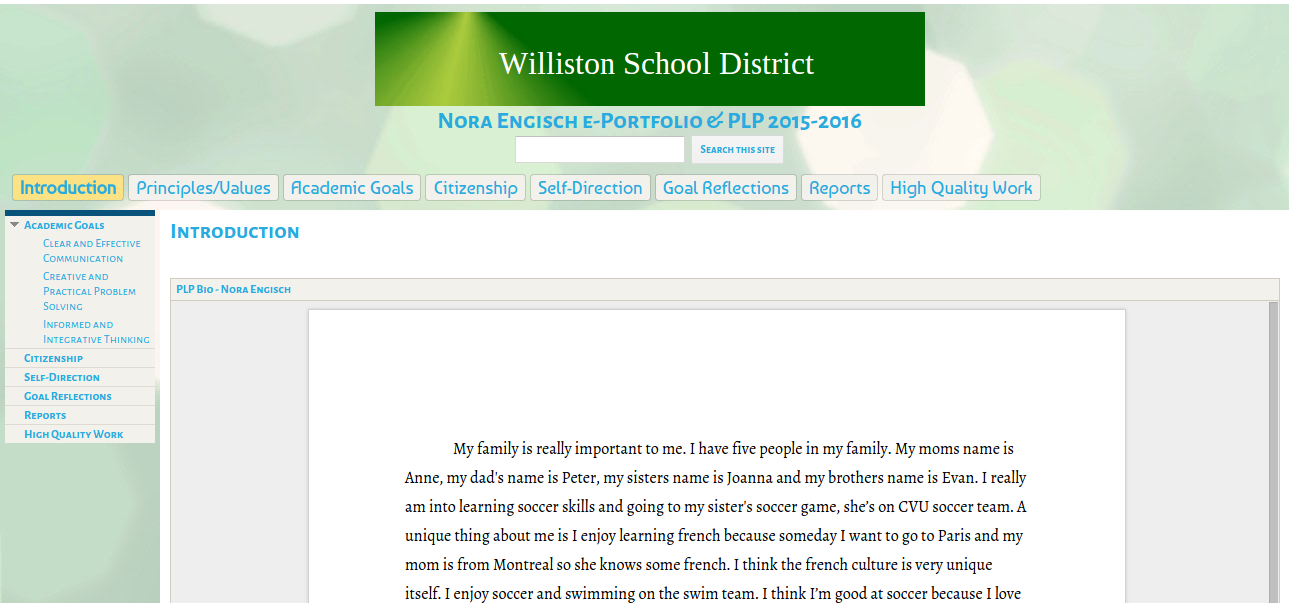
We began our PLP journey by having students write SMART goals in the first months of school.  Jared created a Google Site template, which each student then customized.  The tabs of the Site include Introduction, Goals, Evidence, Community, ELA, Math, Science, and Social Studies.


Screenshot 2016-03-16 at 10.04.10 AM.png
SMART goals included one personal goal and one academic goal.  In December, Joy created an ELA assignment called the PLP Identity Assignment.  Students were required to complete three Google Presentation slides: “Who Am I?”  “How do I Fit Into the Community?” and “What Are my Principles and Values?”  These slides were then inserted into the Introduction and Community pages.


In January, we presented our work with PLPs at the Middle Grades Institute conference at the University of Vermont.  The feedback and support that we received was fantastic.  


In February, students began to prepare for student/parent/teacher conferences.  This year, for the first time, students are beginning conferences by spending twenty minutes with their parents, explaining and celebrating their best work from the trimester via their PLP Site.  Students and parents then transition to their core teacher’s classroom for the remainder of the conference.


All of these tasks were assigned to students via Google Classroom, and had completion point values in the grade book.  During the past two weeks, each core teacher has met individually with the students in their core to go over the PLP and ensure that it is “conference-ready.”  Next week we begin student/parent/teacher conferences.  

Our hope is that the PLP is a place to set goals, display exemplary work samples, and track student growth.  We’re excited about sharing this with parents, and looking forward to PLPs becoming part of Sterling’s learning culture.

Jared can be reached via email at jbailey@cssu.org and Joy at jpeterson@cssu.org. Jared can followed on Twitter @jwbvt.

Monday, February 15, 2016

Swift House: PLP History Part 3

This week we will be featuring the final installment in a series of blog posts from Kevin Hunt, a contributor to PLP Pathways and teacher in the Swift House, Williston Central School. 

PLP Pathways encourages contributions from teachers and educators across the state who are implementing personalized learning or, like Kevin, have integrated it into their programs. This week, Kevin discusses the process for linking goals and evidence, communications with parents, and student-led conferences.

[Swift House] students also have an opportunity to input evidence to their various goal pages. For every piece of evidence that they embed, whether it be a document, presentation, video, or image, the students need to include a couple of sentences on how each piece of evidence directly relates back to their goals. This process of having students write about how their evidence connects to their goals both assures that the evidence they are including has relevance for that specific goal page, and it gives the students another opportunity to reflect and notice the progress that they have made toward reaching their goal. This wouldn’t be as fluid of a process if we did not have flexible scheduling and a house-based team structure. We all are generalists who teach the same content at the same times during the school day. The fact that there are pockets of time within our schedule that we have our entire [Swift] student body present, allows us to make changes to our schedule as needed.


In each core class, we also pair 5th grade students with mentor 7th and 8th grade students. These mentor/mentee pairs are created before the beginning of the school year and the mentors have an opportunity to meet their mentees before the first day of school to introduce themselves and give them some advice from a student’s perspective. We often utilize our mentors during PLP time. Our 7th and 8th grade students, who have already had two-to-three years of experience with our PLP process, work with their mentees to assist them in finding evidence and linking work to their portfolios.


By the end of each trimester, students have at minimum four pieces of evidence (with connections) for each goal, a goal reflection, which states the importance of the goal, successes with meeting the goal, challenges, and next steps, and their various class reports. These pieces are all outlined in their PLP checklist and are reviewed during their student-led parent-student-teacher conferences.


NE PLP.png

Parent Involvement = Greensheets (Friday Sheets)


Students on Swift House complete a weekly Friday sheet that acts as a communication tool between school and home. Students receive these Friday sheets on Thursday and are required to get either an initial from their teachers of their various classes or a circle. An initial represents that students are caught up with all work and have nothing overdue. If a teacher puts a circle next to the class, that indicates that the student owes either classwork or homework, and the teacher will indicate and write down what is owed. Students bring home the Friday sheets over the weekend and bring them back, with a signature from their parents, by Monday. The parents also have an area to initial that indicates that they have taken the time to review their son or daughter’s PLP weekly goal reflection and evidence. This weekly communication assures us that our students parents are being kept in the loop regarding their child’s weekly progress, as well as let us know that they have taken the time to review their child’s PLP, or at the very least acknowledge its existence.


Student-led Conferences


At the end of each trimester, teachers conference with students and parents to review their PLP progress and go over their class reports. These conferences typically last thirty to forty-five minutes and are led by the students. Students spend the majority of time showing their online portfolio, which houses their various PLP goals and evidences. After each goal is reviewed, the PLP team has a conversation about the student’s progress and discusses whether or not the student would like to keep the goal, tweak the goal, or change the goal completely. This provides a wonderful opportunity to students to advocate for themselves and take full control over their learning.

Tuesday, January 19, 2016

Using Labels In Blogger To Support Evidence and Reflection

Returning to school after the winter break, I always feel that I need to refocus my students on their evidence and goal reflections.. At this point in the year they have been working on their goals for enough time to do a larger self-assessment and think about adjusting their goals based on the evidence that they have been collecting.

One of the large challenges of doing this is trying to figure out what system to use with students that allows them one place to put all of their reflection and evidence. It also needs to be easy to use and easy to organize so they can find their evidence to put on the PLP.  At Peoples Academy Middle Level, all of our teams use Blogger. Paired with the use of labels, it has allows students the ability to reflect on their learning throughout the day in one organized place.

With the addition of labels on the blog, students can tag their posts so they will have easy access to evidence demonstrating  growth towards  their goals. Labels also allow students to put multiple labels on one post, allowing students to track goals and growth in all subject areas. Please see an example student blog on the PLP Pathways site.


Maura Kelly is a 7th grade humanities teacher at Peoples Academy Middle Level in Morrisville, Vermont. She has a passion for working with young adolescents and believes in the power of a strong middle level program in developing students to be ready to face challenges in our world today. When Maura is not teaching you can find her out skiing and biking around the state of Vermont.

Tuesday, December 8, 2015

Using Data to Inform the PLP Process

Introduction

With the ubiquity of easy-to-use data collection tools available online, educators implementing personal learning plan programs this fall may want to consider systematizing their data collection efforts. This nuts and bolts organization can help teachers and students evaluate the direction of the program, develop essential feedback loops, and help complete the communication loop created with parents and the community.

Tools and Techniques

In our program, we leverage the ease of Google Forms to gather regular feedback from students regarding the elements of their personal learning plans, effectiveness of the initiative, and student dispositions regarding the personalization of the learning experience.

Educators and teams should spend some time deciding what information they would like to capture and at what intervals they would like to collect data. By setting up regular, consistent calendar dates for collecting feedback, teachers can design a system that not only informs current practice, but provides feedback over time, thus guiding the overall direction of the program. Standardizing questions throughout this process can help teachers identify strengths and challenges in the program.

One note on collecting data (and perhaps an obvious one); make sure that you have an effective labeling system for your data collection. Once your data set becomes more robust, wading through similarly labeled files can create confusion and eat up large amounts of time. Additionally, if you are interested in studying specific cohorts over time, specific labels will help organize your work.

Feedback, Student Input and the Learning Community

A critical element of collecting data regarding implementation of personal learning programs is the discussion and analysis of that data with students. Sharing the collected data (scrubbed of confidential or personal information) can be a huge benefit to teachers and students.

First, it provides students with the broader classroom perspective of the initiative. This can help students understand their role in the classroom community and also how their opinion and input can help shape the direction of that community. Second, data analysis and reflection can be an excellent platform for utilizing and teaching the transferable skills, particularly in areas of communication, collaboration, and use of technology. Finally, communicating data and analysis back to community members and families (some of whom may have participated in data collection activities) can keep them informed about their student's progress and is an important piece of Act 77 and the personal learning plan initiative.

Reflection

Finally, and crucially, collecting data in an organized manner is an essential element of student and teacher reflection. Collectively analyzing data can provide students with the evidence upon which they can begin reflecting on the personalization of their education. By thoughtfully considering not only their own responses, but also those of the learning community, students can be encouraged to reflect on their role in that community, their goals as a student and learning community member, and how they can participate in a more personalized educational future.

For teachers, reflecting on the data from personalization initiatives can be the stepping stone to transformative teaching practices. Students are our most valuable, most important, and most responsive constituents. By utilizing their feedback in an organized way, reflective teachers can leverage that information into real classroom change that engages, motivates, and inspires children through an effective personal learning experience.

Sunday, November 8, 2015

Collaboration into Practice: Using Technology to Improve Student Outcomes

Last year, as part of a personal learning pilot program, we started hosting a webinar called PLP Pathways. Our goal was to utilize a somewhat new technology -- Google Hangouts on Air -- to connect educators who were implementing PLPs in their classrooms.

Having not hosted a webinar before, but intrigued by the possibilities, we managed to host 3 or 4 sessions, had a good time doing so, and decided to see if the project had legs by formalizing the process a bit more for the 2015-2016 school year.

With support from the Middle Grades Collaborative, we created the PLP Pathways webinar series in an effort to determine if this type of long-term, collaborative, web-based professional development could support teachers throughout the school year. In this day and age, that also means incorporating a host of social media platforms (Google +, Twitter, and Google Sites) to promote that effort. Not only was the professional development embedded, so too was the need to learn how to use the social media tools effectively.

The results thus far have been mixed. While the content of the webinars has never been stronger, getting teachers to find time in their busy schedules to watch and participate in a webinar is difficult. Now more than ever, teachers’ time is limited.

Despite these hurdles, the benefits of committing to this type of professional development are undeniable, at least from my perspective. Last month, on October 29th, we held our webinar with guests Kevin Hunt from the Williston Central School and Life LeGeros from the Tarrant Institute. Our conversation focused on student growth and reflection, goal setting, and tying evidence to goals.

This would seem like a logical and easy extension of our personal learning. However, the conversation got me thinking, particularly about the student process of linking goals to specific pieces of evidence from across the curriculum. In order to do so effectively, students must have a deeper understanding not only of their own goals, but also of the objectives behind activities at school, and the different purposes and outcomes of those activities.

When students can independently select evidence that meets the criteria for the learning goals that they have designed, tracked, and reflected upon, real learning is taking place.

In my own practice, I know that I have been guilty of selecting evidence for the kids. That is, if we have completed a big project in language arts, I have asked kids to post that to their PLP whether or not it meets their individual learning goals. And maybe this practice is a good way of enabling students to reflect on their strengths and challenges no matter their learning goals.

Even so, the conversation evolving from our webinar extended my thinking about goals, linking those to evidence, and supporting student growth through by helping them develop the ability to do so independently. This is a simple, but powerful idea that could transform my thinking about goals, evidence, and reflection. This, coupled with our discussion of the REAL Reflection Framework explained by Life, was something that had immediate implications for my classroom practice.

Following the webinar, students were asked to start identifying evidence from across the curriculum that could be added to their PLP. Additionally, students were asked to blog about their strengths, challenges, and goals that they had relative to school-wide activities, not just in my classroom.

Finally, and perhaps most importantly, the webinar resulted in my having conversations with colleagues, specifically foreign-language teachers, about the evidence they were seeing in their classroom that might 1) connect with student goals and 2) reflected students developing academic and social dispositions.  

Connecting these ideas together, and forging that into a cohesive, student-centered, student-driven personal learning plan are direct results of the continuing professional development through the PLP Pathways webinar. Although time is tight, committing to at least some form of this type of professional development can lead to improvements in practice, pedagogy, and collaboration.

Wednesday, October 14, 2015

PLPs and Parent Communications


PLPs and Parent Communications

Late September and early October bring leaf-peepers, spectacular fall foliage, and hopefully, some rhythm to the school year. Among all the activity, and depending on school implementation of personal learning plans, teachers may be considering how to best communicate their work with PLPs to parents and the community.


Parent and educator involvement in the PLP process, including easy access to, and monitoring of the PLP plan, are critical elements of Vermont's Personalized Learning Program. Here are some options to consider when thinking about introducing the PLP process to the community.

Parent Education and Planning

Developing a plan for reaching out and communicating teacher, team, and school plans about the implementation of PLPs can significantly improve parent understanding  of the process and expectations for student work.

To make this successful, teams and teachers should look at the calendar and develop a process for distributing information in a meaningful and cohesive manner. Calendar dates should also be given consideration as events such as Open House and student-teacher conferences can be excellent opportunities to keep parents and the community informed about PLP implementation and what that means for their students.

Educational resources and information for communicating to parents are widely available through the Agency of Education's Vermont PLP Process website. You can also find information on the PLP Pathways web page.

Electronic and Social Media

Depending on teacher and team social media presence, popular platforms such as Twitter, Instagram, and Google+ can be excellent venues for the distribution of PLP related material. Individual, team, or school websites can also be great places to distribute links and material to the community.

Obviously, this requires an understanding of the community's use of technology (and perhaps additional education). That said, these tools can be excellent for supporting implementation of the personalized learning program.

PLP Based Parent Conferences

Conference formats and expectations vary widely from school to school but utilizing the PLP as a foundation for student-parent-teacher conferences can be a great way to introduce parents to the PLP program. This option requires thoughtful planning and clear expectations for all parties.

Here are some thoughts to consider:

  • What elements of the PLP will be viewed or discussed in the conference?
  • What role will the student play -- leading the conference, participant, presenter?
  • What advance preparation is necessary so that students and parents can move through the conference format without confusion or questions?
  • What goals and evidence do students need to have on their PLP to most accurately reflect their academic achievement, social growth, and strengths and challenges?
  • How can the conference be formatted to maximize parent understanding of both the PLP process and student progress?
  • How will teams and teachers document parent involvement in the PLP development process?
  • How will teachers and teams develop feedback systems to identify elements of the conference experience that need improvement?

Admittedly, this is a lot of work and it requires a good deal of planning and preparation. Teams and teachers in the first year of implementation may choose to simply introduce the PLP process to parents at conferences.

Summary

Efforts to educate parents and the community about Act 77 and Personalized Learning Plans can help teachers, teams, and schools develop support for these educational initiatives. By planning ahead, utilizing existing structures where possible, and through the thoughtful implementation of new media and technology, educators can ease the transition to the personalized learning model.