Monday, May 13, 2019

PLP Pathways and Proficiency-Based Learning


In April, PLP Pathways participated in the Proficiency-Based Learning forum co-hosted by Vermont Learning for the Future and Up for Learning. The goal of the forum was aimed at elevating a strengths-based, solution-oriented dialogue about making the transition to PBL in Vermont. The forum provided PLP Pathways an opportunity to reflect on the ways that we have shared in the learning of practitioners from around the state as we work to implement proficiency-based learning and how the personal learning framework supports the shift to PBL.

Three Pillars of Personalized Learning
Personal Learning Plans (Identity/Engagement/Evidence of Growth)
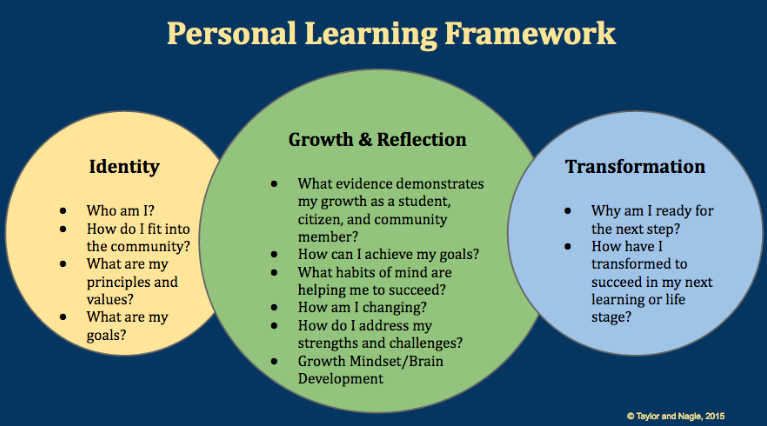

Personal Learning Plans are a critical tool to help educators know students well and to help students develop and achieve clear academic and social goals in order to be productive and socially responsible citizens. The thoughtful development and implementation of PLPs engage students with a variety of learning activities and curriculum connected to their interests. This builds positive relationships with students, increases teacher understanding of students’ strengths and challenges, and provides students voice and choice in the curriculum and help to understand students’ educational aspirations.
 Examples
Proficiency-Based Learning and Assessment
(Evaluating What is Most Important)
Proficiency-based learning requires that students, teachers, and families clearly understand the learning expectations and standards that students must achieve in order to be considered proficient. In addition to academic skills, proficiency-based learning systems separate academic achievement from habits of learning (transferable skills).

Key features of proficiency-based learning include the use of formative assessment, consistent and clear feedback to students, and the opportunity to retake and revise work submissions in order to achieve proficiency. Ideally, students are not measured by the time spent in class but rather their demonstration of proficiency across the curriculum. In proficiency-based learning systems,  “students can demonstrate learning progress and achievement in multiple ways through differentiated assessments, personalized-learning options, or alternative learning pathways.”


Flexible Pathways
(Creating Meaningful Diverse and Equitable Learning Opportunities)

Educators must consider the skills required for students who will be moving into a high school environment with a broad range of academic opportunities available to students. Work-based learning, community internships, dual enrollment, and early college are all elements of Act 77.


Using proficiencies to monitor and assess student learning allows students and teachers to explore these learning opportunities with a common language for assessing performance. When learning expectations are clearly communicated, students, teachers, families, and extended learning providers can ensure student learning and achievement. Additionally, proficiency-based learning is a key component of effective project-based learning curriculum.

Sunday, April 7, 2019

Upgrading Student Led Conferences


Recently, we (Team Dynamix 802) at Main Street Middle School) decided to re-examine the format of our student-led conferences. While we recognized the promise of having students lead our biannual gatherings, in practice, we were having a hard time getting students to carry the conversation and take ownership of the experience. Reflecting on our implementation, we decided to make some changes which, after two days of meeting with families, appear to have potential.

Script Writing

Rather than have students read a prepared script, we made the script-writing of the conference agenda a three day exercise in language arts. First, we had students review and reflect on their PLPs. Using a menu of activities, students identified places where evidence existed and space for adding artifacts of their growth and learning to their personalized learning plan.

After this review, and using resources from Edutopia, we created a graphic organizer to guide students through the process. Highlights included a source of pride and areas for growth. In addition to action steps and resources, students also identified how parents and teachers could help them with these areas of growth.

Practice Presentations

After students completed the drafts of their student-led conference script, we developed a discussion protocol for reviewing and practicing the presentations. Students and a partner each practiced their presentation while the other assessed their performance using a checklist and speaking rubric. Students were coached in a variety of strategies to help with their presentations including repeated reading, the use of Post-it notes for reminders, and multiple opportunities for practice.

Conferences = Feedback = Better Relationships

At the conferences, I was struck by how effectively students were able to use their scripts, and the prompts regarding sources of pride and areas of growth, to articulate their strengths and challenges. Several times, students mentioned sources of pride that I either 1) did not expect or 2) were related to extracurricular experiences that I might never have heard about without the conference venue. This feedback was invaluable and will help me build stronger relationships with these students now that I understand a little bit more about what motivates them.

Feedback, Part 2

As students were speaking and engaging with conference participants, I utilized our team's learning expectations document to take notes and highlight specific learning dispositions identified by the students as areas of growth. These notes will now be incorporated into the trimester reflection.

Closing the Circle

Each trimester, students write a standards-based reflection that highlights their growth and learning and what goals they want to set moving forward. Typically, that is a stand alone writing exercise.

However, with our work preparing for the student-led conferences, much of the prewriting has been completed. Essentially, the conference scripts dovetail with our reflective practice. Next week, with their PLP review, scripts, and conference notes, students will be well-prepared to draft those reflections.

Our writing process, which now includes the student-led conference and verbal articulation of achievement and growth, has transformed into a holistic experience that supports a wide range of literacy and transferable skills.

If you'd like to know more about our process or experience, don't hesitate to be in touch!


Sunday, March 24, 2019

Exploration, The Game of Life and Systemic Inequity: Moving Students Towards the Future They Deserve


On Thursday, March 14th, PLP Pathways convened online for our seventh webinar of the 2018-2019 school year. Our topic, exploration, centered around the idea of building student experiences that focus on independent, student-driven work and that also help students begin exploring opportunities both at school, during the summers, and through college and career exploration. Here are some takeaways from our conversation.

Personal Interest Projects

As we roll into early spring, albeit through a blanket of snow, developing curriculum that allows for independence and exploration can be a great way to start hitting the school year’s home stretch. PLP Pathways contributor Meg O’Donnell discussed her use of Personal Interest Projects to spur student motivation and engagement. Using proficiency-based curriculum standards and transferable skill expectations, Meg encourages students to select topics of interest and then to pursue those topics through a variety of inquiry-based learning opportunities. Allowing students to choose their subject matter, within a project-based learning structure, can provide motivating and engaging learning experiences.

Community Partnerships

Another great way to develop student exploration of community and career opportunities is through the development of community partnerships and learning opportunities. There are numerous angles to approach this but suggestions include identifying guest speakers for classroom appearances, partnering with local organizations to perform service or community-based learning and even the development of flexible pathway internships where students get to engage with adults in the working world.


Our special guest this month was Sam Nelson from the Shelburne Community School. Sam packages student interest in their future, negotiated curriculum and career exploration into a vibrant unit called The Game of Life (click on the link above for more information). Students complete job applications, explore career interests on My Next Move, and even read through the Vermont Driver’s Manual to begin testing the waters of adult responsibility. Again, these types of exploratory learning opportunities can provide students with valuable insights and experience that connect their educational experience with “real life”.

Extracurricular and Summer Opportunities

Another exercise that can help students and families recognize local summer opportunities is the exploration of community organizations, events, and camps that support student interest, relationships and keep kids connected. Local libraries, schools, and parks and recreation departments often provide a wide range of activities that support student learning and growth. Taking time to allow students to find and recognize those opportunities, while also communicating these to parents, can be a great way for students to get excited about summer enrichment.

Issues of Equity

When pursuing community-based learning opportunities, camp, college, and career exploration, or even when working with student negotiated curriculum, educators should be deeply thoughtful regarding equity, equity of access and equity of opportunity. In our webinar conversation, we discussed how summer camp opportunities are “drenched in inequity.” That is, those who have, go, those who don’t have, do not have the same opportunity.

This is a confounding problem and one that we need to disrupt. How can we provide opportunities for all of our students? Helping students and families identify opportunities connected to the school, that have scholarships and funding, or that are free and open to all make for a good start. Whenever conducting or constructing exploratory activities, equity should be a key consideration.

Tuesday, February 19, 2019

Webinar 6: Flexible Pathways

Introduction

What are flexible pathways and why are they important? PLP Pathways contributors got together on Thursday, February 7th to discuss the many different opportunities that flexible pathways provide for students across the state of Vermont.

According to the AOE's website, "...flexible pathways promote opportunities for Vermont students to achieve post-secondary readiness through high-quality educational experiences that acknowledge individual goals, learning styles and abilities." (Agency of Education)

These experiences can include dual enrollment, community-based learning, work-based learning, early college, personalized learning opportunities and more.

Throughout the webinar, we discussed the different "key ingredients" that educators might consider not only in providing flexible pathways for students, but also how we might begin to prepare younger students for future flexible pathways opportunities.

Relationships

Developing positive relationships with students, and creating the structures that grow those relationships, is a critical aspect of developing flexible pathways. Why? By knowing students, their aspirations, hopes, dreams and plans for the future, teachers can develop targeted opportunities for students.

School Based or Community Based?

Because of the opportunities presented by technology, flexible pathways that revolve around blended learning, flipped classrooms or online learning can extend the curriculum and provide students with personalized learning opportunities that are interest based. Khan Academy, work with the United Nations Sustainable Development Goals and student participation with online or web-based curriculum can provide vibrant and dynamic learning experiences for students.

Flexible pathways opportunities can also take place outside of the classroom including place-based learning, work based learning or educational partnerships with local organizations. Check out Montpelier High School's Flexible Pathways learning progression and the wide range of opportunities available to students.

Equity

Whatever your program, and however you implement flexible pathways, creating equitable learning opportunities accessible to all students is essential. Indeed, this can be a key determinant for choosing school-based or community-based learning opportunities. Whatever platform teachers choose, ALL students should have the opportunity to explore these educational experiences.

Essential Skills

As teachers plan for flexible pathway experiences, it always helps to brainstorm or imagine the skills that students will need to succeed. This is particularly true for younger students. What transferable skills can we be integrating into instruction so that when given the opportunities, students will thrive. A sampling of these skills might include: digital citizenship, organization, time management, reflection and self-assessment.

Developing Community Partners

Identifying community partners can be a huge boost to teachers seeking to develop flexible pathways. A primary example is the Vermont Energy Education Program or VEEP. The program provides teachers with professional development and then will visit classrooms to teach students a variety of lessons about energy, conservation and sustainability. More importantly, by joining with community partners such as VEEP, teachers gain access to a network of partners and opportunities that can extend student learning.

Communication

Finally, it is critical that schools and teacher communicate flexible learning opportunities to students AND families. Without strong communications, the opportunities provided by flexible pathways can be missed by those not "in the loop". Creating effective communications structures can ensure that all students have access to these learning experiences and that the school, students and families can make the best decisions for student success.

Resources

If you are interested in growing your flexible pathways or weaving them into your learning community, check out our PLP Pathways webinar or a new site, the Vermont Learning Cooperative.

Monday, January 21, 2019

Reflecting on Webinar #5: Student Empowerment and Negotiated Curriculum


On Thursday, January 10th, the PLP Pathways crew got together for what turned out to be a discussion on student empowerment and negotiated curriculum.

It was fortuitous timing as on January 12th, the Middle Grades Conference took place with many of the presentations and action research projects focused on supporting student voice, choice and the development of empowered decision making.

A driver of our conversation was the importance of partnering with students, on many different levels, to develop learning opportunities and curriculum.

Why? It is our belief that doing so raises the engagement of students, encourages the formation of democratic classrooms, and prepares students for their next life and learning stage. Although our discussion was wide-ranging (check out the video), some key takeaways included the structures that teachers can and are utilizing to increase student engagement by integrating student voice and choice into the curriculum. Here are a few of those observations.

Questioning

Having students develop questions about themselves and the world can be a great way of building relationships, understanding the hopes and dreams of students, and designing and modifying curriculum to meet the needs of students. For intrepid teachers, this can also be the first step in co-designing curriculum with students.

Transferable Skills

Working with students to develop curriculum or to incorporate their views into the direction of the class learning environment can be a great way to practice and use the transferable skills. Responsible decision-making, collaboration, communication and digital citizenship are but a few of the skills that students can utilize when contributing their thoughts, ideas and direction to the class.

Leadership Opportunities

Asking students to participate in the construction of learning can provide multiple opportunities for student leadership. Students can mentor younger classmates, participate in student leadership groups, and lead smaller groups of students in the activities (brainstorming, developing themes, analyzing data, research) needed to build engaging topics of study. By framing these opportunities in terms of leadership, educators can provide intentional spaces for the development of empowered students.

https://goo.gl/EVkr46
Relationships

At the root of this work is the development of strong positive relationships with students. Bray and McClaskey 1 have an excellent overview of how  student voice, when encouraged in the classroom, can lead to the leadership opportunities mentioned above.

Increasing student voice in the classroom can lead to increased levels of trust, co-creation of materials, and positive feedback loops that can engage students and teachers alike. As students become more empowered learners, relationships can deepen, engagement can improve, and learning environments can become dynamic, flexible spaces that accommodate students skills, interests and learning goals.

Learn More

Check out these resources (or watch the video above) for more information and ideas related to empowering students.


Sources

1. Continuum of Voice: What it Means for the Learner . (2016). Personalizelearning.com. Retrieved 21 January 2019, from http://www.personalizelearning.com/2016/01/continuum-of-voice-what-it-means-for.html

Sunday, January 13, 2019

Middle Grades Conference: Efficacy and Equity


On Saturday, January 12, educators from across Vermont reconnected at the Middle Grades Collaborative’s 12th annual conference held at the University of Vermont’s Davis Center.

This year’s conference, titled Personal Efficacy in the Middle, featured presentations covering a range of action research projects being implemented in classrooms throughout the state. The majority of presentations were the continuation or culmination of work started at the Middle Grades Institute in June of 2018. The conference provides a venue for Institute participants to demonstrate, reflect, and share the learning gained from their professional development.

Engagement, student voice and choice, the release of responsibility to students and the redesign of personal learning plans were but a few of the topics under discussion. Readers interested in the range of topics can peruse abstracts of the different presentations here. Listening to educators relate and reflect on their professional growth is incredibly powerful and inspiring. For many of us, the conference provides the opportunity to refresh, consider new ideas and to renew professional relationships that support positive outcomes for educators and students.

After two rounds of presentation and lunch, conference participants were invited to engage in a microlab protocol. Adapted from Julian Weissglass’s work for the National Coalition for Equity in Education based at the University of California, Santa Barbara, microlabs are structured, small-group discussions with guiding questions. At the conference, the microlab questions were based on a definition of educational equity from the National Equity Project. After the initial rounds of small group discussions, larger groups discussed themes and important ideas that were discussed. These issues, around equity in Vermont schools, will be a focus of the 2019 Middle Grades Institute.

The Middle Grades Conference is a wonderful mid-winter reminder of the great work that is happening around the state. By connecting summer professional development with new learning and through re-engagement with Institute participants, teachers have the opportunity to reflect on their mid-year growth and to implement new ideas for the remainder of the school year. It is a powerful, fun, and transformative event. If you would like to be a part of this learning community, please register for the 2019 Middle Grades Institute here.

Saturday, January 5, 2019

Personalized Learning: An International Perspective

This post is from PLP Pathways contributor Alison Gauthier who is 
currently teaching at an international school in China.


My husband and I grew up in Vermont, and taught in central Vermont for several years at a public high school. While discussing purchasing a house one evening during dinner two years ago, we realized that we wanted a different near-future for ourselves. We decided to pursue careers as international teachers. Our mutual love of traveling and adventure was a large contributor to the decision. However, we also wanted to push the edges of our professional comfort zones. Extensive applications, Skype interviews, a job fair, and two contracts later, we signed on to teach Business and Biology in Qingdao, China for two years.

Prior to leaving, we posed every possible question. How different would life and work in Qingdao, China be? Would we be able to handle the transition and continue to be successful teachers in a foreign place? What cultural barriers would come between us and our students? Would we experience “tiger moms” that we had heard about from friends that had visited China? Would the students be able to understand us? Would we fit in?

Since arriving in China to work an all-Chinese private high school this past August, I have found more similarities than differences in the “cultures of education” present in central Vermont and Qingdao, China. While the food eaten and the words spoken look and sound very different between these two cultures, there are several common educational paradigms.

Know Your Students

I have found that circle share-outs to start and end class have been the most useful tool to really get to know my students. By posing a “softball” question to the group (Share one thing you found interesting in today’s lesson, What is your favorite food?, Where is your hometown?, Share one thing you still don’t understand about respiration), I have learned who my students ARE.
Halloween 2018 in Biology class
Individual conversations before or after class, or at lunch time, have also helped me to better understand my students. While the minutes seem limited during the day, being *present* for my students, and taking time to ask them how they are doing and how they families are, has gone a long way in knowing how to help them both academically and socially.


Parents as Partners

In China, the majority of our students are not local, and they board at the school dormitory. This would appear to create  a disconnect between home and school life.

In Vermont, it was commonplace to call parents, email updates, or invite parents in for a discussion. Due to the language barriers and boarding-nature of the school, this connections cannot happen directly between teachers and parents. However, each student has a Chinese-speaking tutor. The tutor is the student’s point person at school, and knows the student best.

The tutor stays with them all four years at the high school, and sees their small group of tutees each morning for 25 minutes. The tutor plays a crucial role as the link between the parents and the school. Through the tutor maintaining trust and a positive relationship/dialogue with the parents (who often live a plane flight away from the school), parents are still partners in the decisions made related to the students.

Listen to your Students

“Feedback is a gift.” When I worked in Central Vermont, my students completed Google forms to give me valuable feedback related to my teaching.

Students in Biology Lab
Within the first two months of teaching Biology here in Qingdao, I devised a similar feedback form for my students. I asked help from a Chinese-speaking Biology teacher with the translation. I was nervous that my students, out of respect and/or fear, wouldn’t give me feedback that I could employ.

However, I was thrilled by the various ideas students had to help me become a better teacher. My students were constructive yet kind in their feedback. Some ideas included using more visuals, having students in the class translate Biological concepts that are confusing, more labs (which I have integrated to once a week at minimum), and more homework problem sets. Accepting feedback and being able to change to accommodate the learner is challenging but essential in the world of education.


Analysis of the Feedback - This was showed to students following the survey.


Conclusions

While the move to living and working in China has been, as is expected, a transition, the core aspects of my teaching have not changed.

The same principles that enabled me to find success in a public high school in Central Vermont are still present here. Best practices don’t change just because the language and food does. Parents still want to be involved in their child’s academics. Students still want to be heard by their teachers, and know that they have a voice. Relationships are still at the heart of the educational culture here in Qingdao, China.