Tuesday, September 20, 2016

Personalization, proficiencies, flexible pathways - the Three Pillars!


This week we will be featuring a post authored by Lindsey Halman, a PLP Pathways contributing author, participating PLP Pathways webinar moderator,  teacher, and founder of The Edge Academy, Essex Middle School.

Personalization, proficiencies, flexible pathways - the Three Pillars!  

As another school year launches, I am reminded of how truly fortunate we are to be educators in VT. I am also reminded that in order to create a learning environment that supports the Three Pillars, we must spend time intentionally creating community, building relationships and creating the norms that will allow all learners to thrive in this world of Act 77.  

Creating Community. What is place?  

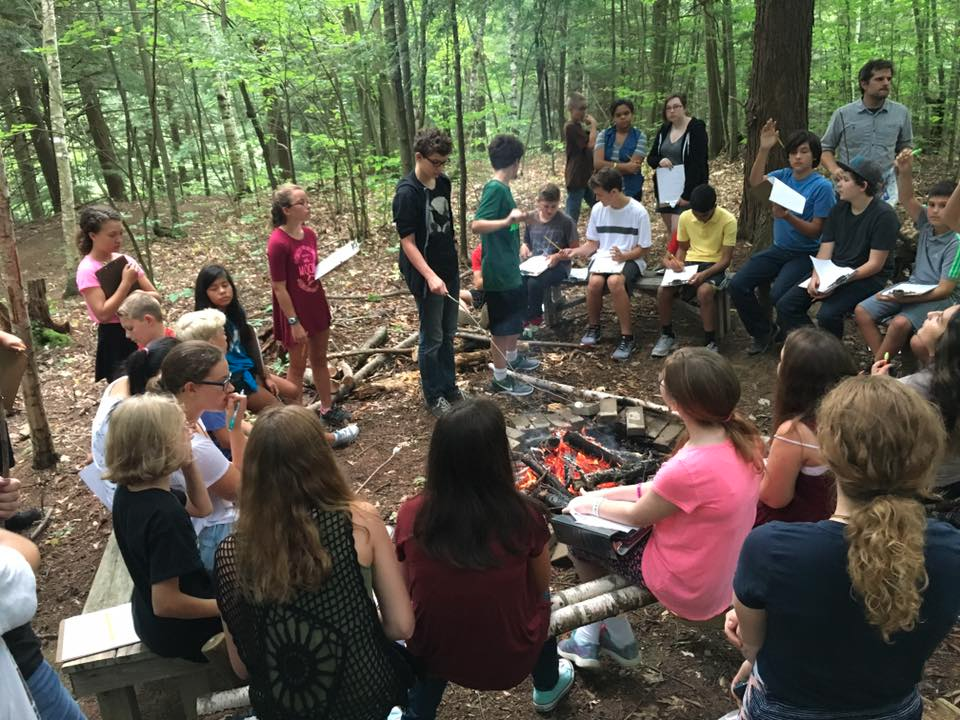
This was the question that launched our year together on the Edge Academy Team at Essex Middle School.  As our 7th and 8th grade learners worked to define this word, they came to realize that place is much more than the physical space.  It’s mostly about our relationships - with one another, with ourself and with the space itself.  Learners identified that when they think of place, they feel safe, supported and respected for their individuality.  We wanted to ensure that the learners on our team understood that “school” is not a physical space, but rather, learning can occur anywhere as long as one feels supported to ask questions and take creative risks.  With this in mind, we spent a large portion of our first day back at Essex Middle School outdoors and unplugged.  In small groups, we explored the ideas of diversity and perspective using a hula hoop outside on a field.  Careful observations were taken of everything found within the hula hoop.  We also asked learners to imagine what they would see if they dug one foot down and how their observations would change.  These observations were shared around a fire, as we discussed the ideas of diversity and perspective.  Marshmallows were roasted as we reflected on what kind of community we wanted to create this year.  Further activities on observation, perspective and diversity connected us to the book Zoom by Istvan Banyai.  This is a fantastic book to use for a variety of lessons on perspective!


Building Relationships.

Each morning, we meet as an advisory in our Circle of Power and Respect (CPR).  This is a given, every day you will walk into your advisory and the circle will always be there to start your day.  We use our (CPR) as a way to connect with one another, share, learn and strengthen our community.   Each learner found an object in nature that had some qualities that represented who they are as an individual.  


“There are three sides to every story: yours, theirs, and the truth.” - Chimamanda Ngozi Adichie

This object and the qualities were shared during our circle and a mobile, or centerpiece for our circle, was created with all of our individual objects.  The mobile is an important part of our CPR. It represents everyone in the circle as individuals and together, the power of our community.  It also serves as a place for focus for students when conversations become tough.   

Sharing Stories, Sharing Pancakes?

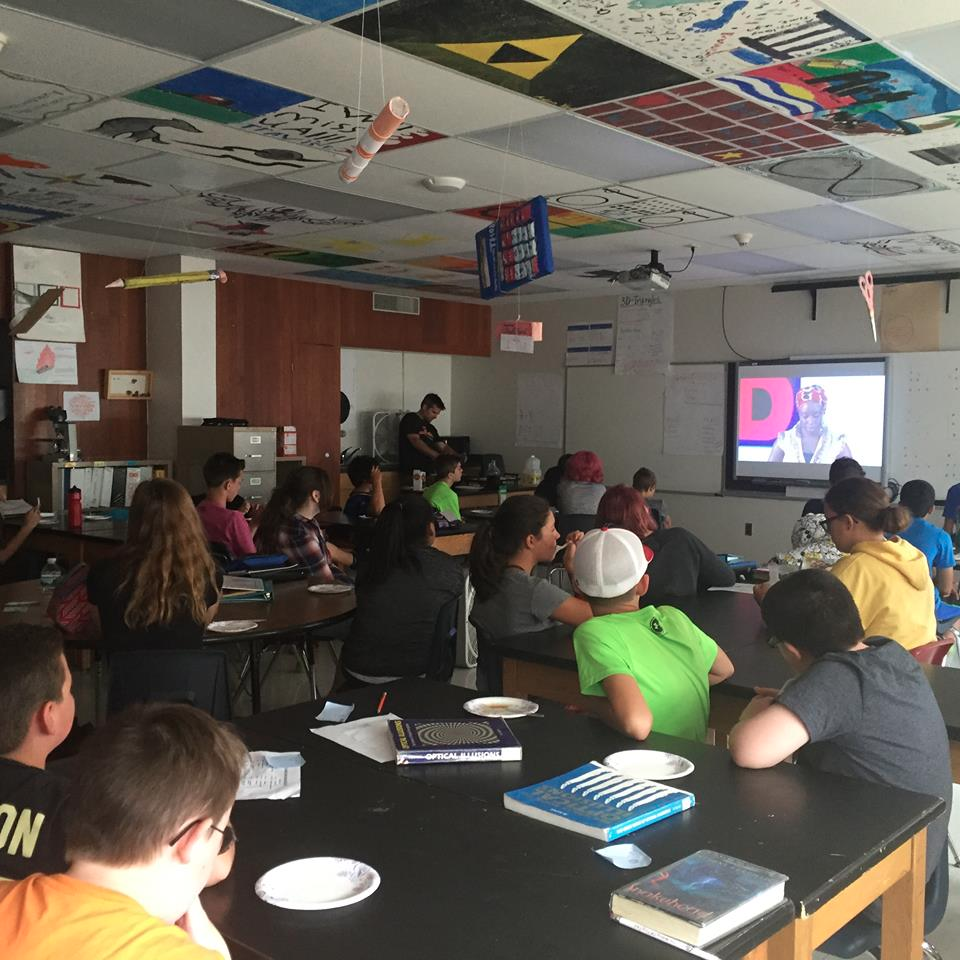
During the first month of school we focus intensely on exploring our identity.  We began our exploration of self by watching a TEDTalk by Chimamanda Ngozi Adichie on how she “found her authentic cultural voice. [She] warns that if we hear only a single story about another person or country, we risk a critical misunderstanding”.  This important message was enjoyed while eating homemade pancakes and our very own Edge Team maple syrup that we produced last spring in our sugarhouse.  This is one way to highlight past projects and the dynamics of our project-based learning model on our team.  

There are so many layers to our identities and in stories, we see ourselves, learn about our world and learn how to make our way in it.  Learners crafted the story of their names, as well as created identity maps.   We also have begun to explore the art of interviewing and listening.  Learners have been conducting interviews to capture the stories of September 11, 2001, from a trusted adult.  Through these experiences, they are developing the critical skills that will be necessary for their project work this year.  
Pushing Personalization Further.

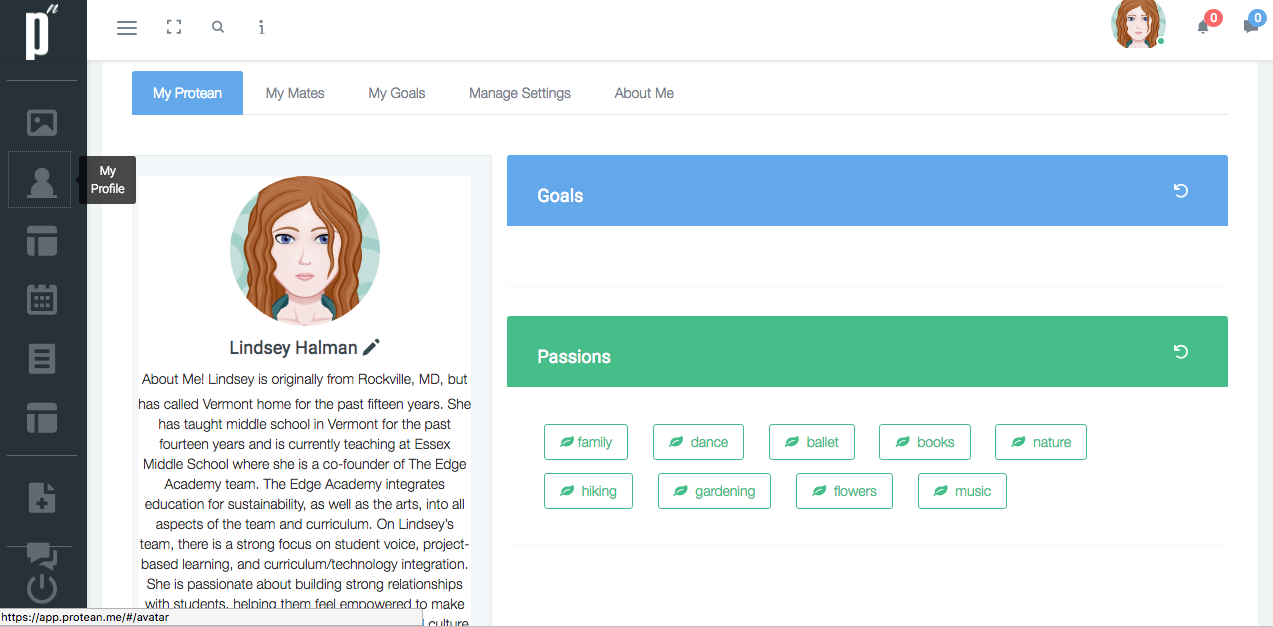
This year the students on the Edge Team, as well as other students at Essex Middle School will pilot Protean as our platform for their PLP.  We are excited to explore the potential of this dynamic platform.  Learners will use Protean to share who they are, what their goals are, and demonstrate proficiency with the Transferrable Skills in a truly personalized manner.  Within both traditional groups (classes) and non-traditional groups, learners will track their progress toward proficiency, document their learning and reflect on it.  We will share more as the year unfolds, but currently, learners have created their avatars and have started to create their bios and tag their passions.  
Screen Shot 2016-09-20 at 6.29.19 PM.png

Self Questions.jpgFlexible Pathways: Start with the questions!   We are always excited to try something new to push our work with our young adolescents further.  But, one thing that always remains at the heart of our team is our Negotiated Curriculum process.  Learners have been working on developing questions/concerns they have about themselves and the world.  In small groups, they are seeking commonalities and from there, extracting a possible theme for the year.  This year we will add a further dimension to our project work and challenge our learners to link their theme and their projects to the United Nations Sustainable Development Goals.  


Tuesday, September 13, 2016

Getting the Ball Rolling with Personalization and Proficiencies

This week we will be featuring a post authored by Kevin Hunt, a PLP Pathways contributing author, participating PLP Pathways webinar moderator,  and teacher in the Swift House, Williston Central School.

The school year is officially under way and we are in full swing! As in previous years, Swift House has front loaded the beginning of the school year with team building and identity work for our PLPs. Our new 5th grade students on our 5th-8th grade team have already done some great thinking about who they are as learners. We established five transferable skill goals with each of our new students and they had an opportunity to ask questions and receive some insider tips from their 7th and 8th grade mentors during our annual mentor/mentee breakfast before the start of the school year. It always strikes me how poised and articulate 7th and 8th graders can be when I hear them explain some of the finer nuances of our various systems on Swift House.

Identity work

The first few school days are loaded with cooperative games, ice breakers, and personal reflection. Between all of the chaos of seeing old friends, meeting new ones, and figuring out where the next class will be, we ask our students to take some time and reflect on who they are. We try to create a new activity for this every year to help engage all of our students. This year, we decided to create “Swiftagram” pages, since so many of our students are familiar--and somewhat obsessed-- with Instagram. We like to keep this first activity light and enjoyable. This is an opportunity for our students to think about the things that make them special and unique and also start exploring what they are most excited about for the coming school year.

We do our best to make sure all of our work has meaning, is relevant, and can help inform future decisions. The Swiftagram pages act as an informal gateway for our students to begin their identity work in our PLP framework. What may seem like a fun and somewhat trivial assignment of drawing pictures of things you like and commenting on what excites you about school, is actually an assignment that carries a great deal of weight; these middle school students begin to recognize and think about who they are as unique individuals and as learners. This work typically excites students and we harness this excitement for personalization as we move forward in the school year.

There is a seamless transition from the informal identity work of  Swiftagram pages to the work that ultimately is uploaded to the identity section of the PLP. We ask that students create a brief autobiography for their identity page. We present this work as a core (our lingo for homeroom) journal. We are intentional in instructing students to present this information in a format of their choosing. We’ve found that limiting students to a specific medium such as writing has a detrimental impact on their ability to produce a meaningful autobiography. There are so many tools and resources with technology that allow all students to let their voices be heard. We try to access and utilize these to create personalized opportunities whenever we can.

Communication

Communication and transparency are key ingredients for a good start to any school year. As educators, we commit hours over the summer and during professional development days to learn about and gain mastery in the newest initiatives that our state and districts have to offer. Now that ACT 77 is in full swing, the focus in our district has centered around proficiency based learning (PBL) and the nuts and bolts that come with it: assessment, reporting, and implementation. The teachers have gained insight and tools to ready themselves for the start of the school year. The next piece of this puzzle is to communicate this learning--and in some cases, paradigm shift--with parents and community members.

Swift House is in an interesting situation as it has been using a version of proficiency-based learning for some twenty-five years. We  started our school year with a similar approach to what we have done in the past: summer mailing  to new 5th grade families and returning 6th-8th grade families, hopes and dreams conferences, mentor/mentee breakfast, team building, and identity work for our PLPs. Since our returning students have already been exposed to our system with proficiencies and PLPs, we utilize this time before the start of the school year to not only make our new 5th grade students feel welcome, but also inform them and their families about our process.

During our hopes and dreams conferences, parents and students are asked to bring in a student profile sheet that we sent out in our summer mailing. This profile sheet outlines the student’s strengths and challenges within various transferable skills categories and most importantly, provides insight about the student’s likes, dislikes, hobbies, and interests. This is an important part of our process as the student is given a voice and opportunity to advocate for him or herself from the very first conference, which helps later on in the year with our student-led conferences. We use this opportunity to learn about the whole student and also engage them with the goal setting process, while introducing them to the transferable skills. We work together as a PLP team (student, teacher, guardian) to create meaningful goals for each of the transferable skill categories. This is often the time when parents will ask about our grading policies as well. We’ve found that taking the time in this first conference to talk face-to-face and explain our philosophy around proficiency-based learning has had a profound impact on how the rest of the year (and subsequent years) will go. Once parents and students are introduced to our system from that first meeting and understand our expectation and teaching philosophy, there are seldom any questions or complaints to follow.

Since our entire district has completely moved to PBL, there has been a greater volume of information going home to all parents about the shift, which in turn has brought up more questions about PBL than we have had in the past. Though we haven’t had to make any philosophical changes to our practice on Swift House, it has provided an opportunity for us to take a step back and reflect on not only how we are using PBL, but why we do it. On a professional level, this has also become inspiring work to both share with other educators and learn what others think about PBL and how they are implementing it. Just recently, we adopted a ‘crash course to PBL’ document that was created by a group of progressive teachers in Shelburne Community School. As the Swift House teachers revised the original document to fit our team, it sparked thoughtful and productive conversation amongst us, especially regarding communication and transparency with parents.

As the state continues to shift towards proficiency based grade requirements, it is so important that we are being as open with communication as we can with parents. Though there can be a sense of dissonance between this work and the traditional system that so many are used to, it’s important to keep in mind that payoff that this has for student learning and investment.

Wednesday, September 7, 2016

Building a Learning Community

Over the next few weeks, we'll be featuring teachers throughout Vermont as they implement personal learning in their classrooms. Today's post is by Don Taylor of Main Street Middle School in Montpelier.

Across the state, teachers and students have spent the first few days of school establishing norms, getting to know their new students and creating positive learning communities. Working with the guidelines provided by Act 77, educators are venturing into new territory on three fronts: personalized learning, proficiency-based learning, and flexible pathways. The Middle Grades Collaborative and Tarrant Institute for Innovative Education have created a model for understanding these pillars of personalized learning in support of educators and students (see graphic).
Courtesy of the Middle Grades Collaborative


Team Summit at Main Street Middle School in Montpelier has focused the first few days of school developing scaffolded instruction aligned with the Personal Learning Framework. Students entering the Team Summit learning environment spent time framing their identity as individuals, students, and citizens (in real time and in the digital world) of the Team Summit community. This initial brainstorming will serve as the basis for the Identity section of student personal learning plans.

In a new development, Summit students were then asked to translate Vermont’s transferable skills into student-friendly language. Students ranked the skills in order of importance and in small groups, identified the ten most important behaviors reflected in those standards. Subsequently, students will vote on the top ten transferable skills and dispositions required for success on Team Summit. Those student-selected dispositions will then become our Team Summit Constitution.

As students continue to work through the Identity stage of the Personal Learning Framework, their understanding of the transferable skills will help them to develop initial goals. This scaffolding will allow us to begin the Growth and Reflection phase earlier than in years past. Additionally, working with the transferable skills in kid-friendly language facilitates the use of common language that can be used across personal and proficiency-based learning.


Student translation of transferable skills
Furthermore, by incorporating elements of personal learning and the PLP into the development of the learning community, teachers and students can begin building relationships based on student strengths, challenges, and goals. Building these relationships early can be a key factor in student and team success.

Tuesday, August 30, 2016

The Journey Begins

Educators across the state are preparing to meet their new students and embarking on the long educational journey that spans September to June. Anticipation, excitement, and expectation are percolating and it’s a great time of year.

Many of us will implement new learning, engage and motivate students, and challenge ourselves with new strategies, topics, and ideas.

There are lots of questions too. How will your year shake out? What strengths and challenges will our students bring to the classroom? How will our classroom community operate and to what end will we build community, support the growth of our students, and prepare them for the future they desire?

As we move towards a more personalized, engaging learning experience, it is critical that we take the time to remember the importance of giving each student a fresh start, of letting our students share their strengths and challenges, and supporting all of our students in a just, equitable manner that honors their passion, creativity, and interests.

It is also important that educators sustain this initial momentum across the school year. To assist teachers implementing personalized learning, integrating proficiency-based education, and exploring extended learning opportunities, PLP Pathways will continue to provide resources, forums, and information regarding the great work of Vermont’s students and educators. Please follow us on Twitter @PLPpathways and Google +.

Good luck and have a great start to the 2016-2017 school year.

Saturday, June 25, 2016

PLP Pathways Partners with Vermont NEA

In a continuing effort to develop quality professional development to Vermont educators, PLP Pathways recently partnered with the Vermont NEA to deliver a one day workshop on the implementation and use of PLPs in the classroom titled:  Middle School PLPs and ePortfolios


On Monday, June 20th, Don Taylor and Kevin Hunt, PLP Pathways contributors, collaborated with 10 participants from across Vermont to work on PLP development. A huge thank you to Julie Longchamp, Director of Professional Development for the Vermont NEA whose support, guidance, and willingness to explore professional partnerships made this event possible.


Participants will have the opportunity to continue the work started on the 20th with an "Open Classroom" that will occur at the Vermont NEA's Summer Academy on August 3rd at Champlain College. Additionally, pending interest, the workshop may be presented a second time on August 2. Registration for both events can be completed here. Registration is free for Vermont NEA members.

If you are interested in the offerings at the NEA's Summer Academy, please check out the online course catalog.  

Monday, June 13, 2016

Design Thinking: PLP Edition

Over the course of the year, Peoples Academy Middle Level has been actively partnering with the Tarrant Institute for Innovative Education (TIIE) around the implementation of PLPs and Proficiency Based Graduation Requirements. Due to this partnership, PAML was invited to participate in a Student Design Thinking Challenge around PLPs in the Middle Level. Collaboration occurred between students from  Hazen, Lamoille, Peoples Academy Middle Level, Crossett Brook and Shelburne Community School. Each school took a small group of students from a variety of grade levels to participate in this work.

The purpose of this collaboration was to get students from TIIE partner schools to work together to evaluate and redesign their PLPs to better meet the goals of Act 77 and improve student engagement. This collaboration will be ongoing over the course of next school year and the inaugural meeting was in May at the University of Vermont.

Lori Lisai, a current Rowland Fellow and educator from Lamoille Union Middle/ High School, facilitated the day using the Design Challenge framework to inspire creative problem solving.  Lori lead participants through the process  by having students first start with a design challenge of identifying how they learned the best individually. Students then collaborated with students from their school, narrowing the ideas to four commonalities among learning styles.  The second challenge was to creating a group handshake that exemplified all of the learning styles that we had within our group.

Now that our groups were warmed up and ready to tackle some hard thinking, our students set out to learn more about the design process and how it relates to the PLP. Students started by receiving some education around Act 77 to clarify the purpose of their work. Next,  students conducted empathy interviews with students from a variety of schools. The focus of these interviews was to share the current PLP experience at the other schools to get a sense of what the “problem” may be.
Screenshot 2016-05-18 at 4.15.09 PM.png

Once students had a chance to conduct their empathy interview, they then defined the focus of their design by creating a “problem statement.” This problem statement was structured as: Stakeholder (name) needs a way to (verb that is a need) because (insight). From these problem statements students then went to the ideate stage of the design thinking process where they brainstorm for creative solutions within their school groups.


The students from PAML went into a Post-It  note frenzy  jotting down all types of ideas around how we could improve out PLP at PAML. Here is a list of the most frequent ideas:

  • Increase Student Motivation
  • Education around Act 77 - how does setting goals, blogging and reflecting all tie into this
  • Freedom around goal setting:
    • Maybe only one goal that you care a lot about
    • Maybe a goal around a hands-on project that you are working on
    • Students working with a group of teachers to plan how the PLP work time should go - the types of activities etc.
    • More work around motivation for goal setting with examples of goals because it is hard to come up with them on demand
    • More freedom on how they set up their portfolio - maybe not just a google site.

From this ideate students went back to their schools to continue thinking about PLPs and will be rejoining at the Middle Grades Institute at Castleton State University in June to create a PLP plan that they will implement next year. These schools will continue their collaborations over the course of the school year and will be presenting their work at the Middle Grades Conference in January as a way to share growth and learn together.