 Williston Swift House facilitators Amy Skapof and Kevin Hunt, a contributor to the PLP Pathways professional development program, had the opportunity of presenting Swift House’s structure and PLP/e-Portfolio process to educators from across the state at the annual VITA-Learns Dynamic Landscapes Conference in Burlington, VT. Participants learned about how Swift has been implementing Personal Learning Plans for over 25 years, while now meeting the critical elements laid out by Act 77.
Friday, May 27, 2016
PLPs @ Dynamic Landscapes
Williston Swift House facilitators Amy Skapof and Kevin Hunt, a contributor to the PLP Pathways professional development program, had the opportunity of presenting Swift House’s structure and PLP/e-Portfolio process to educators from across the state at the annual VITA-Learns Dynamic Landscapes Conference in Burlington, VT. Participants learned about how Swift has been implementing Personal Learning Plans for over 25 years, while now meeting the critical elements laid out by Act 77. 
Tuesday, May 10, 2016
Integrating Personal Learning Plans Into Practice
At this point in the year, you've probably had some experience either 1) implementing personal learning plans in your classroom, 2) planning for PLP implementation, or 3) hearing about personal learning plans through your professional learning networks.
Assuming this is the case, let's consider four ideas that might broaden the conversation and the possibilities of personal learning plans as transformative learning tools for teachers and students.
Principles of the PLP Become Principles of Your Curriculum
On Team Summit, we're using a PLP template that incorporates seven elements of learning that we consider to be essential for middle level students.
 Those seven are: Identity, Community, Principles and Values, Goals, Citizenship, Evidence, and Exploration.
Each of those elements is given space within the PLP for students to demonstrate growth and learning within the context of that element.
For example, as students build knowledge and reflect on the meaning of citizenship, why not connect that to key ideas in the curriculum? For example, how did the idea of citizenship shape the Greek civilization? What does it mean to be an "active citizen" in Vermont? How are themes of citizenship woven into your classroom?
By connecting these key ideas from the personal learning plan to classroom curriculum and practice, teachers can build greater student understanding and connection to learning.
Mentoring Programs To Build Transferable and Citizenship Skills
Schools with multiple grades can incorporate student expertise with personal learning plans and associated technology into semi-formal and formal mentoring programs. Eighth graders, having years of experience with PLPs, can easily transition into leadership and teaching roles that support younger students as they create their own learning plans.
Mentoring programs allow students to develop better understanding of their own skills and create opportunities for leadership and citizenship within the building. As a result, equity of opportunity for all students can be created without leaving the school.
Use The Personal Learning Framework as a Narrative Structure

To guide students through a personal learning experience, students are asked to use the Personal Learning Framework to identify their progress through the program. In addition to helping students understand the different elements of the PLP (see above), the Personal Learning Framework provides students with guiding questions to help evaluate their growth and learning.
As an auxiliary exercise, students can explore their movement through the Personal Learning Framework in a narrative structure. The first part of their story can be the character development (Identity), the rising action and conflicts can be the strengths and challenges exhibited through the Growth and Learning stage, and the resolution can be a modified Transformation. Drawing on their real-life experience, students can use the Personal Learning Framework to craft their unique story.
The PLP As A Technological Maker Space
Google Sites may not be the most aesthetically pleasing or easily constructed PLP platform, but once students have the basic template, they can begin constructing or “making” their PLP into a custom online platform that reflects their academic and technological growth.
Just as students are “making” in computer labs, “making” with 3D printers, and “making” with game-based modeling, these same concepts of student-led construction can be applied to Google Sites. Creativity, graphic design, and unique elements of website construction can help students learn and demonstrate a variety of tech-based skills.
Wednesday, April 6, 2016
PLP Collaboration at PAML
Here at Peoples Academy Middle Level, we were fortunate to have two professional development days over the past month and a half. One of components of our work during the professional development time was meeting in vertical teams to discuss the implementation of portfolios and proficiency based learning. This time proved to be greatly valuable -- all of the teachers came away with deeper understandings that will impact our practice.
At our meetings, the 5th grade team identified a key challenge to implementing portfolios; the struggle students have with setting goals. Fifth grade teachers were finding that some students were having a hard time identifying a goal, or they were creating goals that we not realistic, relevant or connected to the transferable skills. Knowing that our lower middle level students enjoy partnering with upper level students, we decided to have our 7th grade students collaborate with the 5th graders on their goals work.
To make this successful for all students, we had the 5th grade students start with a goal setting template so that they would arrive at their goal setting meeting with 7th grade students sharing some ideas around a goal. At the same time, we had our 7th grade students look at a SMART goals template, similar to what the 5th graders were using, and try to develop questions to help guide the 5th grade students.

After giving students time to prepare, we set up an hour block of time where our 5th and 7th grade students would meet with a goal partner. Students were reminded of expectations and then got right to work. The 5th grade students introduced their ideas for their goals and the 7th grade students acted as guides and facilitators. Many 7th grade students shared their own PLP sites, experiences, successes and challenges as a way to help guide the 5th grade students. Once the partnership reached a point that they felt the goal was a SMART goal, they collaborated on a Keynote that will go on the 5th grade PLP in preparation for student led conference that they will present in the spring. In thinking about next year, we have hopes of building a robust PLP mentoring program as a way for multi-age collaboration and support to occur with the PLP.

Here are some of the thoughts of our 7th grade students on their experience of helping the younger students:
“Being able to teach them the knowledge you have, feeling important to their learning.”
“Getting to that moment when they finally understand what you're saying, and they start cooperating with you.”
Helping the 5th grade students helped me to:
“It made me think about how my goals related to own my life and how I could improve upon my goals, as well as help them improve on their goals.”
“It helped me think of what I needed to change on my goal.”
“It helped me take a reality check on my goals.”
Wednesday, March 23, 2016
Sterling House Implements PLPs
This blog was co-authored by Joy Peterson and Jared Bailey. Joy and Jared are teammates on Sterling House at Williston Central School. Joy is the ELA teacher and Jared is the math teacher.
Act 77 requires students to develop a PLP starting in grade 7. Here on Sterling House at Williston Central School, we are 5/6 interdisciplinary team. In the fall, we began to explore PLPs at a faculty meeting in which Don Taylor presented his PLP work to us.
While Act 77 does not impact us directly, we took the view that we could begin to prepare our students now, by implementing PLPs in 5th and 6th grade, and help them to be familiar with the process when they reach 7th grade.
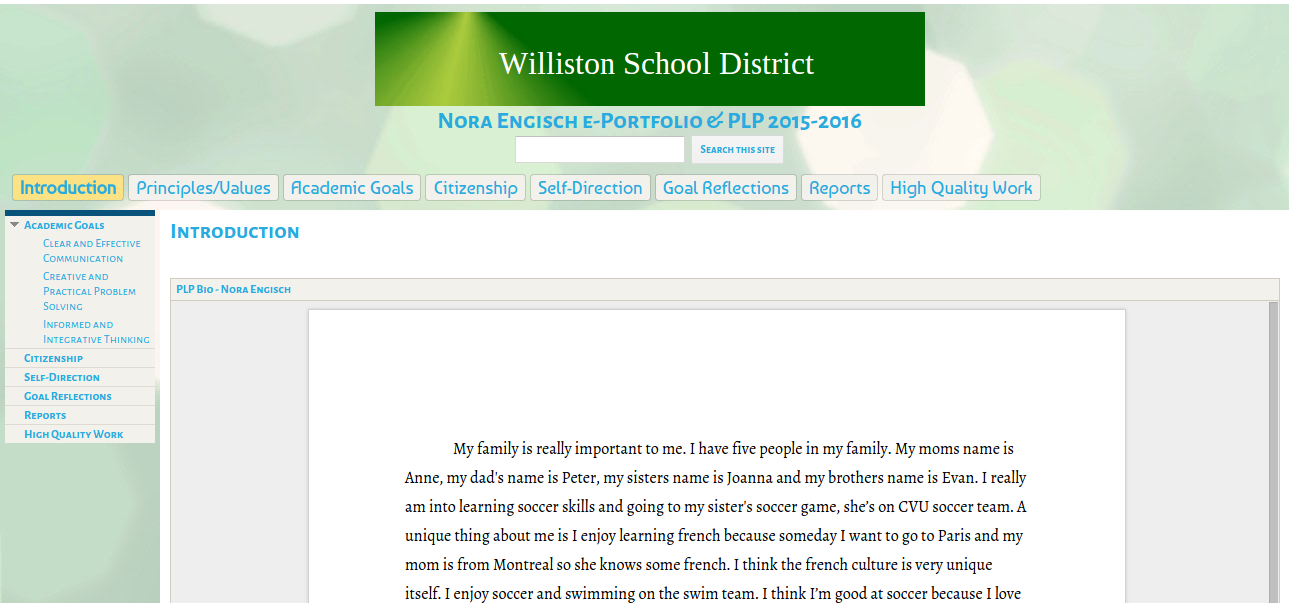
We began our PLP journey by having students write SMART goals in the first months of school. Jared created a Google Site template, which each student then customized. The tabs of the Site include Introduction, Goals, Evidence, Community, ELA, Math, Science, and Social Studies.

SMART goals included one personal goal and one academic goal. In December, Joy created an ELA assignment called the PLP Identity Assignment. Students were required to complete three Google Presentation slides: “Who Am I?” “How do I Fit Into the Community?” and “What Are my Principles and Values?” These slides were then inserted into the Introduction and Community pages.
In January, we presented our work with PLPs at the Middle Grades Institute conference at the University of Vermont. The feedback and support that we received was fantastic.
In February, students began to prepare for student/parent/teacher conferences. This year, for the first time, students are beginning conferences by spending twenty minutes with their parents, explaining and celebrating their best work from the trimester via their PLP Site. Students and parents then transition to their core teacher’s classroom for the remainder of the conference.
All of these tasks were assigned to students via Google Classroom, and had completion point values in the grade book. During the past two weeks, each core teacher has met individually with the students in their core to go over the PLP and ensure that it is “conference-ready.” Next week we begin student/parent/teacher conferences.
Our hope is that the PLP is a place to set goals, display exemplary work samples, and track student growth. We’re excited about sharing this with parents, and looking forward to PLPs becoming part of Sterling’s learning culture.
Jared can be reached via email at jbailey@cssu.org and Joy at jpeterson@cssu.org. Jared can followed on Twitter @jwbvt.
Friday, March 4, 2016
Negotiated Curriculum: The Questions Come from the Kids
This week's contributor is Lindsey Halman. She has taught middle school in Vermont for the past fourteen years and is currently teaching at Essex Middle School where she is a co-founder of The Edge Academy team. The Edge Academy integrates education for sustainability, as well as the arts, into all aspects of the team and curriculum.
The Edge Academy has adapted a model we call “Negotiated Curriculum” from the work of James Beane. This model begins with the learners developing questions and concerns they have about themselves and the world. The strength of this collaborative curriculum model is in its coherence and permeability. It is “coherent” through its holistic approach to content areas by integrating subjects, rather than approaching them as a set of fragmented, unrelated topics. In this way, it reflects the natural relationship between different disciplines of knowledge. It is “permeable” as it is based on learners’ own questions about themselves and about the world, and on the facilitators’ understandings of questions the world poses to learners. This permeability provides room for learner choice and voice. Learners’ questions are rich and from these questions, learners develop their ideas for their project work.
Once our learners have developed their questions and/or concerns about themselves and the world, they work in small groups to find commonalities amongst their questions. During the process of sharing questions, this helps to establish relationships as well as trust amongst their team members. As they listen to one another’s questions, they are carefully considering their own and if there are commonalities.
Once they have discovered the commonalities amongst their self and world questions, they begin the process of extracting themes. This is a challenging, process for young adolescents that involves critical thinking skills and intense collaboration. In this process they are asked to connect their common questions to big ideas, such as change, future, conflict, creativity, etc. As facilitators, we can model and guide our learners through this process, yet the outcomes are completely up to their questions and the collaboration that they experience in their groups/
Each group then agrees upon one theme to develop. This process involves creating a systems web to show the connections between the theme and the different aspects of curriculum on our team. This is the only time, throughout the year, that we ask the learners to think about their theme in connection to discrete subject matter (humanities, math and science). We find this to be an important part of the process so that they can demonstrate their understanding of how this theme can be integrated into all of their learning. We also ask them to think about how it connects to: sustainability, the arts, technology and our community. When thinking about the community, school, town, state and global, we ask the learners to also think about who in the community could help advance their project work.
After our theme posters are created, each group creates a short presentation of their theme for the team. This allows the students to not only practice their presentation skills in front of a large audience, but it provides them with an opportunity to articulate their hopes and dreams for our project work. Posters are then displayed in a “gallery” and our learners are expected to take the next day to ponder the themes and think about the theme that best aligns with their interests and passions.
We then use a process called “Dotmocracy” to determine our overarching theme for the year. Each member of the team (learners and facilitators) receives two colored dots to use as votes for the theme they think will most align with their interests and passions. This process not only models a democratic process, but it honors each individual's voice on our team by providing them with the opportunity to make their own choices in regards to our pathway for the year.
Once a theme is selected, learners spend time thinking about the theme. For example, when we had the Creativity: If you can think it, you can make it!, learners spent a couple of weeks thinking about the word creativity and exploring how they use creativity in their own lives. As facilitators we provide them with articles, videos, experts and activities to develop a foundation for their project work. Small projects occur in order for the facilitators to “teach” the essential skills that will be needed for their year-long projects. This involves teaching how to research effectively, document learning and share their learning with others. During our Creativity theme, we had our learners research the one innovation/invention that they felt was the most important in human history. They then had to find evidence to back up their claim and create a short presentation to the team to convince them that their innovation/invention was the most important. From there, we had learners think about what creativity means to them and then using any medium they chose, they demonstrated what this word meant to them. We had learners create videos, felting, drawing, writing, building, etc., to demonstrate their creativity.
Once the foundation of the theme has been built, we provide learners with some space and time to think about what their project might look like for the year. This is the key component of the negotiation process. Once they have brainstormed their ideas for projects they submit them to the facilitators. My teammate and I then review their project proposals and think about groupings, topics, resources, etc. to make these projects possible.

Monday, February 15, 2016
Swift House: PLP History Part 3
This week we will be featuring the final installment in a series of blog posts from Kevin Hunt, a contributor to PLP Pathways and teacher in the Swift House, Williston Central School.
PLP Pathways encourages contributions from teachers and educators across the state who are implementing personalized learning or, like Kevin, have integrated it into their programs. This week, Kevin discusses the process for linking goals and evidence, communications with parents, and student-led conferences.
[Swift House] students also have an opportunity to input evidence to their various goal pages. For every piece of evidence that they embed, whether it be a document, presentation, video, or image, the students need to include a couple of sentences on how each piece of evidence directly relates back to their goals. This process of having students write about how their evidence connects to their goals both assures that the evidence they are including has relevance for that specific goal page, and it gives the students another opportunity to reflect and notice the progress that they have made toward reaching their goal. This wouldn’t be as fluid of a process if we did not have flexible scheduling and a house-based team structure. We all are generalists who teach the same content at the same times during the school day. The fact that there are pockets of time within our schedule that we have our entire [Swift] student body present, allows us to make changes to our schedule as needed.
In each core class, we also pair 5th grade students with mentor 7th and 8th grade students. These mentor/mentee pairs are created before the beginning of the school year and the mentors have an opportunity to meet their mentees before the first day of school to introduce themselves and give them some advice from a student’s perspective. We often utilize our mentors during PLP time. Our 7th and 8th grade students, who have already had two-to-three years of experience with our PLP process, work with their mentees to assist them in finding evidence and linking work to their portfolios.
By the end of each trimester, students have at minimum four pieces of evidence (with connections) for each goal, a goal reflection, which states the importance of the goal, successes with meeting the goal, challenges, and next steps, and their various class reports. These pieces are all outlined in their PLP checklist and are reviewed during their student-led parent-student-teacher conferences.
Parent Involvement = Greensheets (Friday Sheets)
Students on Swift House complete a weekly Friday sheet that acts as a communication tool between school and home. Students receive these Friday sheets on Thursday and are required to get either an initial from their teachers of their various classes or a circle. An initial represents that students are caught up with all work and have nothing overdue. If a teacher puts a circle next to the class, that indicates that the student owes either classwork or homework, and the teacher will indicate and write down what is owed. Students bring home the Friday sheets over the weekend and bring them back, with a signature from their parents, by Monday. The parents also have an area to initial that indicates that they have taken the time to review their son or daughter’s PLP weekly goal reflection and evidence. This weekly communication assures us that our students parents are being kept in the loop regarding their child’s weekly progress, as well as let us know that they have taken the time to review their child’s PLP, or at the very least acknowledge its existence.
Student-led Conferences
At the end of each trimester, teachers conference with students and parents to review their PLP progress and go over their class reports. These conferences typically last thirty to forty-five minutes and are led by the students. Students spend the majority of time showing their online portfolio, which houses their various PLP goals and evidences. After each goal is reviewed, the PLP team has a conversation about the student’s progress and discusses whether or not the student would like to keep the goal, tweak the goal, or change the goal completely. This provides a wonderful opportunity to students to advocate for themselves and take full control over their learning.
Monday, February 8, 2016
Swift House PLP History: Part 2
This week we will be featuring the second in a series of blog posts from Kevin Hunt, a contributor to PLP Pathways and teacher in the Swift House, Williston Central School. PLP Pathways encourages contributions from teachers and educators across the state who are implementing personalized learning or, like Kevin, have integrated it into their programs. This week, Kevin discusses the process for selecting and reflecting on evidence as part of the PLP process.
Portfolio and Reflection
Portfolio and Reflection
We use Google Sites as a platform for our online portfolio/PLP. The portfolio acts as the ‘medium’ that houses the PLP, which includes the ‘process.’ Each core teacher (there are four core teachers with roughly one-hundred students divided into the four core classrooms) creates an online roster for his or her core class and uses the add-on Site Maestro to blast out the e-Portfolio template that we use. Using Site Maestro allows us to keep a record and have quick accessibility to all of our core students’ PLPs as well as add bulk collaborators if needed (ie. other teachers, guidance counselors, etc.).
Once the students receive the template, they have the option to personalize their background and font. As a personal learning plan, we want the students to have as much say and control over the process as possible. They add their goals to the various tabs and under the “Goal Reflections” tab, they create a table, indicating what their five goals are. The Goal Reflection page is created as an ‘announcement page’ (mini blog), so students can have an ongoing record of their goal reflections, which occur on a weekly basis.
We have built in a thirty minute block of time each week within our core (homeroom/advisory) class for students to work on their PLPs. During this time, students write a blurb in their goal reflections page, in which they provide input on progress they’ve made on their various goals that week, or if they haven’t made progress, they write what their next steps should be. This process keeps the students reflecting on a regular basis and creates a sense of accountability to commit to working on or at very least thinking about their goals.
Subscribe to:
Posts (Atom)