Monday, February 15, 2016

Swift House: PLP History Part 3

This week we will be featuring the final installment in a series of blog posts from Kevin Hunt, a contributor to PLP Pathways and teacher in the Swift House, Williston Central School. 

PLP Pathways encourages contributions from teachers and educators across the state who are implementing personalized learning or, like Kevin, have integrated it into their programs. This week, Kevin discusses the process for linking goals and evidence, communications with parents, and student-led conferences.

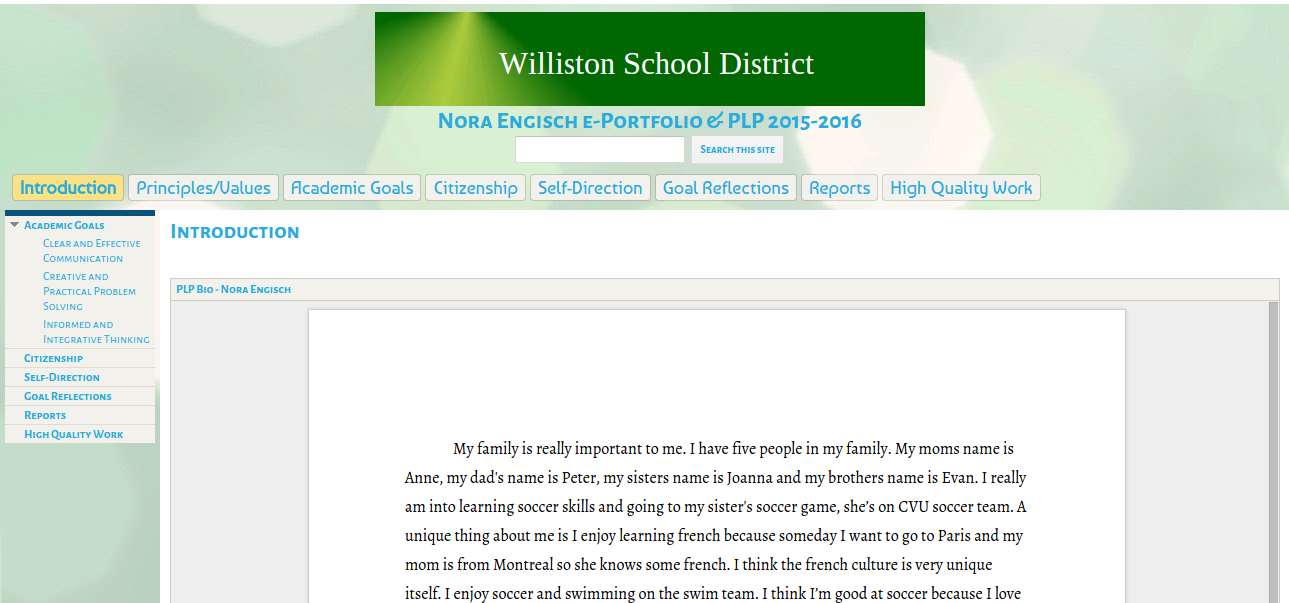
[Swift House] students also have an opportunity to input evidence to their various goal pages. For every piece of evidence that they embed, whether it be a document, presentation, video, or image, the students need to include a couple of sentences on how each piece of evidence directly relates back to their goals. This process of having students write about how their evidence connects to their goals both assures that the evidence they are including has relevance for that specific goal page, and it gives the students another opportunity to reflect and notice the progress that they have made toward reaching their goal. This wouldn’t be as fluid of a process if we did not have flexible scheduling and a house-based team structure. We all are generalists who teach the same content at the same times during the school day. The fact that there are pockets of time within our schedule that we have our entire [Swift] student body present, allows us to make changes to our schedule as needed.


In each core class, we also pair 5th grade students with mentor 7th and 8th grade students. These mentor/mentee pairs are created before the beginning of the school year and the mentors have an opportunity to meet their mentees before the first day of school to introduce themselves and give them some advice from a student’s perspective. We often utilize our mentors during PLP time. Our 7th and 8th grade students, who have already had two-to-three years of experience with our PLP process, work with their mentees to assist them in finding evidence and linking work to their portfolios.


By the end of each trimester, students have at minimum four pieces of evidence (with connections) for each goal, a goal reflection, which states the importance of the goal, successes with meeting the goal, challenges, and next steps, and their various class reports. These pieces are all outlined in their PLP checklist and are reviewed during their student-led parent-student-teacher conferences.

NE PLP.png

Parent Involvement = Greensheets (Friday Sheets)


Students on Swift House complete a weekly Friday sheet that acts as a communication tool between school and home. Students receive these Friday sheets on Thursday and are required to get either an initial from their teachers of their various classes or a circle. An initial represents that students are caught up with all work and have nothing overdue. If a teacher puts a circle next to the class, that indicates that the student owes either classwork or homework, and the teacher will indicate and write down what is owed. Students bring home the Friday sheets over the weekend and bring them back, with a signature from their parents, by Monday. The parents also have an area to initial that indicates that they have taken the time to review their son or daughter’s PLP weekly goal reflection and evidence. This weekly communication assures us that our students parents are being kept in the loop regarding their child’s weekly progress, as well as let us know that they have taken the time to review their child’s PLP, or at the very least acknowledge its existence.


Student-led Conferences


At the end of each trimester, teachers conference with students and parents to review their PLP progress and go over their class reports. These conferences typically last thirty to forty-five minutes and are led by the students. Students spend the majority of time showing their online portfolio, which houses their various PLP goals and evidences. After each goal is reviewed, the PLP team has a conversation about the student’s progress and discusses whether or not the student would like to keep the goal, tweak the goal, or change the goal completely. This provides a wonderful opportunity to students to advocate for themselves and take full control over their learning.

Monday, February 8, 2016

Swift House PLP History: Part 2

This week we will be featuring the second in a series of blog posts from Kevin Hunt, a contributor to PLP Pathways and teacher in the Swift House, Williston Central School. PLP Pathways encourages contributions from teachers and educators across the state who are implementing personalized learning or, like Kevin, have integrated it into their programs. This week, Kevin discusses the process for selecting and reflecting on evidence as part of the PLP process.

Portfolio and Reflection


We use Google Sites as a platform for our online portfolio/PLP. The portfolio acts as the ‘medium’ that houses the PLP, which includes the ‘process.’ Each core teacher (there are four core teachers with roughly one-hundred students divided into the four core classrooms) creates an online roster for his or her core class and uses the add-on Site Maestro to blast out the e-Portfolio template that we use. Using Site Maestro allows us to keep a record and have quick accessibility to all of our core students’ PLPs as well as add bulk collaborators if needed (ie. other teachers, guidance counselors, etc.).


Once the students receive the template, they have the option to personalize their background and font. As a personal learning plan, we want the students to have as much say and control over the process as possible. They add their goals to the various tabs and under the “Goal Reflections” tab, they create a table, indicating what their five goals are. The Goal Reflection page is created as an ‘announcement page’ (mini blog), so students can have an ongoing record of their goal reflections, which occur on a weekly basis.


We have built in a thirty minute block of time each week within our core (homeroom/advisory) class for students to work on their PLPs. During this time, students write a blurb in their goal reflections page, in which they provide input on progress they’ve made on their various goals that week, or if they haven’t made progress, they write what their next steps should be. This process keeps the students reflecting on a regular basis and creates a sense of accountability to commit to working on or at very least thinking about their goals.

Tuesday, February 2, 2016

Swift House: A History of Personalized Learning

This week we will be featuring the first in a series of blog posts from Kevin Hunt, a contributor to PLP Pathways and teacher in the Swift House, Williston Central School. PLP Pathways encourages contributions from teachers and educators across the state who are implementing personalized learning or, like Kevin, have integrated it into their programs.

Swift History

Swift House, a grade 5-8 team that is part of the upper house (middle school level) at the Williston Central School in Williston, Vermont, was formed in the school year 1990-91 as a response to planning sessions that were held beginning in 1988 to deal with projected rapid growth in school population in the town.  Swift has a vision that has sustained nearly 25 years and has been utilizing personal learning plans and student portfolios since its opening year. The research on learning and the needs of the future citizens of this global world validates what we are doing.  

Goal Setting

With new 5th graders beginning their years as middle schoolers, it is essential to involve them in their own goal setting process from the start. Before we begin our school year with our Hopes and Dreams conferences, we send home a summer mailing to our new families and include a profile document for both the new students and the parents to fill out. These documents outline the Vermont Agency of Education’s Transferable skills as well as have the students and parents identify strengths, challenges, and other information that help to create the student’s identity both as a learner and as a unique human being.

The four core teachers on Swift House set up conferences a few days before the start of the school year to meet the new 5th grade students and families and review the student profile pages. These “Hopes and Dreams” conferences are our first meeting as a PLP team (student, parent, teacher). We go through the student profile page and as we discuss the various transferable skill categories, we begin to brainstorm goals for the school year.

In previous years, Swift House has used the Vermont Vital Results as the overarching category for our students Personal Learning Plan goals. We made the switch to the Transferable skills when Champlain Valley Union High School, the district high school, switched their graduation requirements to proficiency based, with the five transferable skills categories at the foundation. It was an obvious choice for us to make the switch to help our students familiarize themselves with the transferable skills before heading to high school, where they would also have PLPs due to the passing of Act 77.

During the goal-setting portion of our hopes and dreams conferences, we provide samples of goals that students have used in previous years, which are categorized into the five transferable skills categories;these help us to start the brainstorming process if a student is stuck on what a goal for a specific category might sound like. By the end of these conferences, we’ve had an opportunity to meet the new families, learn more about our new 5th grade students, and establish five goals that will act as the foundation for their Swift House PLP.

Thursday, January 28, 2016

Hazen Union: Linking PLPs, Identity, and the Community

Our incredible team of Hazen Union 7th and 8th grade teachers have been working collaboratively and intentionally over the past year to create opportunities for all students to feel empowered in addressing the mission of our middle level.  "The middle level years are important in building students' social and emotional skills, as well as developing their abilities to communicate, work with others, be creative, and problem solve. By instilling these skills in our young students we give them the opportunities to express themselves and explore their interests in order to prepare them for the next stage of their lives."


Our team gathered last summer at the Middle Grades Institute with a tremendous task at hand: create a sequence of learning that blends a community-focussed interdisciplinary unit, negotiated learning, personalized learning plans (PLPs), digital citizenship, and the rollout of our 1:1 iPad initiative.  With the support of Susan Hennessey and the Tarrant Institute for Innovative Education, our middle level team developed dynamic curriculum and experiences to begin and sustain through the school year.  


In addition to this work, we have worked hard at sharing our story.  The middle level has created a blog to reflect on a variety of experiences, to which teachers and students contribute.  Our school has begun podcasting, interviewing students and faculty on numerous subjects.  And most recently, we created a video (to be shared at the Middle Grades Conference) documenting our journey:


Great things are happening here at Hazen and it is only the beginning.  Our students have built strong foundations for their PLPs, engaged in meaningful ways with their school and town communities, and developed a rich understanding of their digital footprints.  As educators, we are continually amazed by the learning and work produced by our thoughtful and skilled students.  We look forward to a great second semester and the opportunity to reflect, refine, and revise the work we have started.  


(If you have any questions, please feel free to contact me at jcraig@ossu.org or on Twitter @OldManCraig.)

Tuesday, January 19, 2016

Using Labels In Blogger To Support Evidence and Reflection

Returning to school after the winter break, I always feel that I need to refocus my students on their evidence and goal reflections.. At this point in the year they have been working on their goals for enough time to do a larger self-assessment and think about adjusting their goals based on the evidence that they have been collecting.

One of the large challenges of doing this is trying to figure out what system to use with students that allows them one place to put all of their reflection and evidence. It also needs to be easy to use and easy to organize so they can find their evidence to put on the PLP.  At Peoples Academy Middle Level, all of our teams use Blogger. Paired with the use of labels, it has allows students the ability to reflect on their learning throughout the day in one organized place.

With the addition of labels on the blog, students can tag their posts so they will have easy access to evidence demonstrating  growth towards  their goals. Labels also allow students to put multiple labels on one post, allowing students to track goals and growth in all subject areas. Please see an example student blog on the PLP Pathways site.


Maura Kelly is a 7th grade humanities teacher at Peoples Academy Middle Level in Morrisville, Vermont. She has a passion for working with young adolescents and believes in the power of a strong middle level program in developing students to be ready to face challenges in our world today. When Maura is not teaching you can find her out skiing and biking around the state of Vermont.

Tuesday, January 12, 2016

Benefits of Continuous Professional Development

This weekend educators from across the state gathered at UVM's Davis Center to discuss their work implementing personalized learning and elements of Act 77 at the Middle Grades Collaborative's Personalized Learning in the Middle Grades Conference.


Many of the participants had attended the Middle Grades Institute in the summer of 2015 and reuniting, sharing stories, and receiving insights and teaching tips was an invaluable experience.


Perhaps more importantly, the opportunity to reconnect over the course of the school year allows for reflection and a return to the professional development goals set six months ago.


Often, educators get wrapped up in the speed and complexity of the school year. Goals, objectives, and initiatives identified during the relaxed days of summer are hard to keep going. By attending ongoing professional development, educators can be rejuvenated and re-introduced to the theories, ideas, and pedagogy that would perhaps be lost without these events.


Additionally, these events often build consensus around issues that need to be addressed in future professional development opportunities. At this weekend's conference, themes of scheduling, class structure, and time for implementation were at the top of the list.

Recent blog posts by the Tarrant Institute have addressed some of these concerns and more resources are in the pipeline. You can stay connected by visiting the Tarrant Institute, the Middle Grades Collaborative, or by following PLP Pathways.

Wednesday, January 6, 2016

Collaboration on Goals

This week, we've been collaborating on two fronts with regards to setting goals and how teachers can best implement the goal-setting process. Life Legeros of the Tarrant Institute has been working with Crossett Brook Middle School as they implement goal-setting with growth mindset. Check out their presentation here: Goal Setting Resources.


Additionally, a colleague requested some examples of student goals to show their staff and students. An example can be seen at left.

This ongoing collaboration has been particularly effective in keeping up to speed with personalization and elements of Act 77. You can check out more information, resources, and contributions from educators around the state at PLP Pathways.